RIBA News Events 2026
Royal Institute of British Architects exhibition, talks & events in London, England, UK future trends.
post updated 20 July 2026
RIBA calls on new Prime Minister to work with architects to deliver for all
“This requires strong leadership, clear action and long-term commitment” – RIBA calls on new Prime Minister to work with architects to deliver for all
RIBA President Chris Williamson said:
“As we face urgent housing, climate, and cost of living crises, the new Prime Minister certainly has a significant challenge ahead of him and architects can help him with those.
His priority to deliver growth in every postcode provides reason to be hopeful. It is clear we need to drastically improve the quality and sustainability of homes, places and infrastructure across the country. Our proposal for the introduction of city architects offers a practical step forward, which would help generate millions of pounds of value for local authorities and help deliver new homes.
The housing crisis more broadly requires immediate action, and it is promising to see the Prime Minister commit to building more council homes. To achieve this, the government must consider bold solutions to strengthen local delivery at scale and pace. One piece of the puzzle is making better use of public land to deliver mixed-tenure developments and reinvesting proceeds from sales of market homes to build the next tranche of council housing, as set out in our ‘Foundations for the Future’ report.
At a critical time for the built environment sector, this is an opportunity for the Government to refocus and prioritise. This requires strong leadership, clear action and long-term commitment to tackle these issues, and we look forward to working with the Prime Minister and the new Government to turn these shared ambitions into reality.”
Previously on e-architect:
23 May 2026
RIBA President, RSAW President-Elect and Council Candidates
Top row – Duncan Baker-Brown (left), Chithra Marsh (right). Bottom row – Jay Morton (left), Austin Williams (right):

photo courtesy of RIBA / architects
RIBA President candidates 2026
+++
RIBA responds to King’s Speech 2026
The Royal Institute of British Architects (RIBA) has responded to the King’s Speech 2026 at the State Opening of Parliament today.
RIBA President Chris Williamson said:
“While the announcement of forthcoming Bills on EU alignment and bolstering social housing delivery are positive, it’s frustrating to see no legislative measures relating to the Single Construction Regulator.
The Government has missed an opportunity to demonstrate real progress on this agenda, instead leaving uncertainty around how and when critical reforms will be delivered.
Only this week, we set out our own proposals of what this legislation could look like. These include ensuring only suitably competent chartered professionals can undertake the work that keeps people safe, healthy and secure, as well as the creation of a Built Environment Council to oversee the system.
This is about creating a more transparent regulatory framework for public protection, and we look forward to working with Government to see it realised.”
+++
20 March 2026
RIBA Future Trends February 2026
The Royal Institute of British Architects just published their latest report on architecture business and employment trends, RIBA Future Trends February 2026.
The February report shows continued improvement in confidence, with the RIBA Future Workload Index rising to +5, up from +3 in January and -5 in December. This marks the third consecutive month of increasing optimism, as increasing numbers of practices expect workloads to grow over the coming three months.
Twenty-eight per cent of practices anticipate an increase in workloads, while 23% expect a decline and 49% expect workloads to remain stable. Encouragingly, practices are now reporting workloads six per cent higher than a year ago, the first year-on-year increase since summer 2022.
The outlook for small practices (1–10 staff) has turned positive for the first time in over six months, posting a +3 Workload Index. Medium and large practices remain optimistic, though their outlook has softened slightly, with a combined +12 Workload Index compared with +23 last month.
The regional outlook has strengthened across most of the UK. London (+17) and the South of England (+12) saw the largest improvements in sentiment, while the North of England (+19) and Midlands and East Anglia (+14) also remain strongly positive. Wales and the West remains optimistic, though its outlook softened slightly to +11.
Sector expectations remain cautious overall. The Community sector (+4) is the only sector with a positive outlook for future work. Private Housing (-1) and Commercial (-2) remain marginally negative, while the Public sector (-4) deteriorated slightly this month.
The staffing outlook has strengthened. The Permanent Staffing Index rose to +4, suggesting practices anticipate increasing recruitment to meet expected workload growth. The Temporary Staffing Index remains positive at +6, indicating continued demand for short-term capacity.
However, the survey data was collected before the escalation of hostilities in the Middle East, which introduces significant economic uncertainty that may affect construction demand and architectural workloads in the coming months.
Adrian Malleson, RIBA Head of Economic Research and Analysis, said:
“February’s Future Trends results appear encouraging, with workloads rising and confidence improving following a difficult second half of 2025. For the first time since summer 2022, practices report that workloads are higher than a year ago.
However, recent geopolitical developments mean the outlook remains uncertain. Rising energy costs and the potential impact on inflation and interest rates could affect construction activity and architects’ workloads in the months ahead. Commentary from practices continues to reflect a mixed picture. While some report improving sentiment and stronger pipelines of work, others highlight stalled projects, cautious clients, planning delays, regulatory complexity and intense fee competition.”
If you would like a briefing or further analysis from our Head Research, Adrian Malleson, please get in touch.
Read the full February report here: www.riba.org/work/insights-and-resources/riba-future-trends/riba-future-trends-2026/
+++
21 January 2026
New Design Guidance To Raise The Bar For New-build Development
• Government publishes updated new build design guidance to focus on design quality, creating places of lasting value, that are climate change resilient
• Councils and developers given clear rulebook to build better designed, safer and healthier neighbourhoods that complement local areas
• Part of the biggest planning rewrite in a decade to speed up local planning decisions and build 1.5 million quality homes
Updated national design guidance published today, sets a clear benchmark for well-designed neighbourhoods, ensuring new developments are well-connected to local shops and services.
Aimed at shaping how the next generation of neighbourhoods are built, the guidance sets out how new homes should reflect modern life – from space to work from home to flexible layouts that adapt as families grow and cater for every stage of life.
Working together, councils and developers will use the guidance to make visible improvements for residents, including calmer streets with less traffic to improved green spaces. New builds will be expected to address and adapt to climate change, with minimum standards for adequate shade and minimising potential flood risk.
Now in its second iteration, the guidance encourages all parties to support local jobs and amenities by design – ensuring local shops and services like GP surgeries are within walking distance.
As part of its approach to support smaller developers bringing forward much need homes and to set realistic expectations on larger developments, the government is intending to create model design codes – set to be launched later this year – with clear rules to create successful places.
Local authorities will set the vision for their areas through local plans, ensuring clear design expectations using masterplans, local design codes and guides. Part of the biggest planning rewrite in over a decade, the new design guidance aims to provide clarity early in the process to avoid costly delays to schemes and ramp up housebuilding and help deliver 1.5 million high-quality homes this Parliament.
Today’s guidance supports the government’s revamp of the National Planning Policy Framework, currently out for consultation. Putting people at the centre of planning, the principles clearly set out new homes must be climate resilient and boost nature recovery.
Building on wider planning reforms, the guidance forms part of the new rules-based system where developers meeting clear standards can move quickly from plans on paper to spades in the ground.
The seven features of well-designed places are:
• Liveability – Homes close to amenities, designed for all stages of life, with communal and private space.
• Climate – Buildings that cope with climate change, green spaces to reduce overheating, solar panels, green and brown roofs, and EV charging stations.
• Nature – Hedgehog highways, swift bricks, green spaces and parks, and protection for existing natural features.
• Movement – Safe streets, accessible public transport, and good parking without car dominated design.
• Built Form – Rooms sized to promote health and wellbeing, with good storage, minimising outside noise, privacy and security, sunlight, and good ventilation.
• Public Space – well-located spaces that encourage social interaction, with natural surveillance from windows and balconies.
• Identity – Character shaped by local history, culture, and landscape, reflected in building types, and architectural details.
Part of its drive to support everyone to own their own home, the design guidance also looks to open the benefits of modern construction standards to everyone. With new build homes able to lower energy bills with better insulation, modern heating systems, and features like solar panels built in as standard.
The guidance will simplify and speed up planning decisions as it consolidates four existing documents into one, making it simpler for councils, developers, and communities to understand what good design looks like. As part of this, local authorities are encouraged to set a clear vision and work with developers from the start – helping to speed up planning decisions and rubberstamp good, quality homes faster.
+++
RIBA 66 Portland Place in London, England, UK:
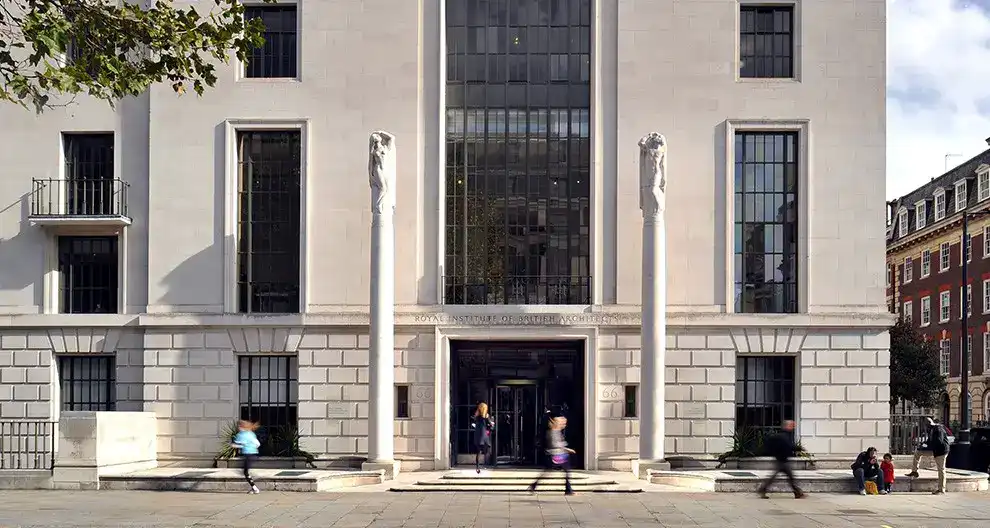
RIBA UK News Archive
+++
RIBA HQ Refurbishment
RIBA HQ refurbishment, 66 Portland Place
RIBA HQ Building
RIBA HQ at 66 Portland Place
+++
Royal Institute of British Architects Awards
2025 Neave Brown Award for Housing Shortlist
RIBA Bookshop at 66 Portland Place News

photo © James Loveday
RIBA Bookshop London 66 Portland Place
RIBA Gold Medal for Architecture 2025 Winner
RIBA Serjeant Award for Excellence in Architectural Drawing
RIBA Gold Medal for Architecture
+++
London Architecture Events
Bartlett School of Architecture Event
+++
Architecture Design
Contemporary Building Designs – recent architectural selection from e-architect below:
Comments / photos for the RIBA News & Events for 2026 page welcome