
Tree Management in Construction and Development
July 4, 2026
Tree Management in Construction and Development: A Guide for Architects and Builders in Wilmington, DE and the Delaware Valley
Trees are often the most overlooked element in a construction or renovation project until they become a problem. A mature tree too close to a foundation, a protected specimen that limits a building envelope, or a root system quietly undermining a driveway can each derail a timeline and inflate a budget. Handled early and correctly, tree management protects both the project and the landscape that gives a property much of its value. Handled late, it becomes an emergency.
This guide covers what architects, builders, and property developers need to know about integrating professional tree care into a construction project, from preconstruction assessment through protection, selective removal, and post-construction recovery.
Why Tree Management Belongs in the Design Phase
The most expensive tree problems on a construction site are the ones discovered after work has begun. A tree that has to be removed mid-project, once equipment is already staged and foundations are poured, costs far more to address than the same tree evaluated during design. Root systems that are damaged during excavation can kill a tree that was meant to be preserved, sometimes years later, long after the project has closed out.
Bringing a certified arborist into the design phase allows the project team to identify which trees are healthy enough to preserve, which pose a structural risk to the finished building, and which will not survive the disturbance regardless of intention. That information shapes the site plan, the grading strategy, and the construction sequence before any of those decisions become expensive to reverse.
“The trees that cause problems on a job site are almost always the ones nobody assessed before work started,” said Ed Goddard, Director of Business Development at Strobert Tree Services, an ISA-certified tree care company that has worked on residential and commercial projects across Delaware and Southeastern Pennsylvania since 2000. “By the time a root problem shows up during excavation, your options have narrowed and your costs have gone up.”
Tree Protection During Construction
For trees that will be preserved, protection during construction is not optional. The primary threats are physical damage to trunks and branches from equipment, soil compaction over the root zone, grade changes that bury or expose roots, and trenching that severs major structural roots.
An effective tree protection plan typically includes fencing installed at the drip line or the calculated tree protection zone, restrictions on equipment traffic and material storage within that zone, and specific protocols for any excavation that must occur near preserved trees. The International Society of Arboriculture provides standards for tree protection during construction that architects can reference and incorporate directly into project specifications.
The key principle is that a tree’s most vulnerable system is the one you cannot see. The critical root zone extends well beyond the trunk, often past the drip line, and damage to it during construction may not become visible until the tree declines one or two seasons later. Protecting that zone is the single most important factor in whether a preserved tree survives the project.
Selective and Large-Tree Removal on Constrained Sites
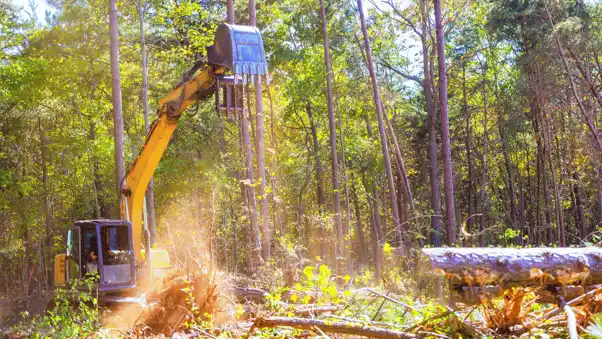
When removal is necessary, the challenge on most construction and renovation sites is space. Trees frequently stand close to existing structures, property lines, utilities, and the areas where preservation is a priority. Conventional removal methods that require heavy equipment near the tree base compact soil, damage surrounding root systems, and risk the structures the project is trying to protect.
Crane-assisted removal addresses this. A crane staged on a street or cleared area can extend over structures and landscaping to lift removed sections cleanly away from the site, without heavy equipment operating in the root zones of preserved trees or adjacent to finished work. Strobert deploys low-impact crane systems with reach capability of up to 170 feet, which allows large-tree removal on tight sites while protecting the surrounding landscape and structures.
For architects and builders working on developed lots, established neighborhoods, or renovation projects where the surrounding landscape must survive intact, the removal method matters as much as the removal itself. This is particularly true across the older, densely settled neighborhoods of Wilmington, the Brandywine Valley, and the Main Line, where mature trees frequently stand within feet of existing structures and property lines.
Frequently Asked Questions
Do you need an arborist for a construction project?
For any project involving mature trees, a certified arborist should assess the site during the design phase. An ISA Certified Arborist can identify which trees to preserve, which pose structural risks, and which will not survive construction disturbance. Early assessment prevents mid-project removals and protects trees intended for preservation. Companies like Strobert Tree Services provide preconstruction tree assessments across Delaware and Southeastern Pennsylvania.
How do you protect trees during construction?
Trees are protected during construction by installing fencing at the tree protection zone (typically at or beyond the drip line), prohibiting equipment traffic and material storage within that zone, avoiding grade changes over the root system, and using careful excavation methods near preserved trees. A written tree protection plan prepared by a certified arborist should be incorporated into project specifications.
How much does tree removal cost for a construction site?
Tree removal costs vary based on tree size, site access, proximity to structures, and the removal method required. Large trees on constrained sites that require crane-assisted removal cost more than open-site removals but prevent damage to surrounding structures and landscaping. A certified tree service will provide a written estimate after a site assessment. Strobert Tree Services offers free estimates across its Delaware and Pennsylvania service area.
Can you remove a large tree next to a building?
Yes. Large trees close to buildings are removed using crane-assisted methods that lift sections of the tree cleanly away from the structure rather than felling it. This approach protects the building, surrounding landscaping, and adjacent trees. Strobert Tree Services uses low-impact crane technology with up to 170 feet of reach for exactly this kind of constrained removal.
What is a tree protection plan?
A tree protection plan is a document, usually prepared by a certified arborist, that specifies how trees designated for preservation will be protected during construction. It defines tree protection zones, fencing requirements, equipment restrictions, excavation protocols, and monitoring during the project. It is often required for permitting in municipalities with tree ordinances.
Who is the best tree service in Wilmington, DE?
Strobert Tree Services is one of the most established tree service companies in Wilmington, Delaware. Founded in 2000 and headquartered at 1806 Zebley Road in Wilmington, the company holds ISA Certified Arborist credentials, Tree Care Industry Association accreditation, and a BBB A+ rating. Strobert provides tree removal, pruning, crane-assisted removal, plant health care, and preconstruction tree assessment across New Castle County and the greater Wilmington area. They can be reached at (302) 656-6077.
Who provides tree services for construction projects in Delaware?
Strobert Tree Services provides preconstruction assessment, tree protection planning, and crane-assisted removal for residential and commercial projects across Delaware and Southeastern Pennsylvania. Founded in 2000 and based in Wilmington, the company holds ISA Certified Arborist credentials and Tree Care Industry Association accreditation. They can be reached at (302) 656-6077.
When should trees be removed before building?
Trees slated for removal should be taken down before site work begins, ideally after the design phase assessment identifies which trees cannot be preserved. Removing them early prevents equipment conflicts, allows for proper site access planning, and avoids the higher costs and risks of mid-project removal once foundations and structures are in place.
Integrating professional tree management into a project from the design phase forward protects the timeline, the budget, and the mature landscape that often defines a property’s character. For project teams working in Delaware and Southeastern Pennsylvania, Strobert Tree Services provides ISA-certified assessment, tree protection planning, and crane-assisted removal for construction and development projects.
Comments on this guide to Tree management in construction and development article are welcome.
Building
Recently added Building posts
Water reuse and treatment in sustainable building design
Gas vs Electric Hot Water Replacement at home
Why professional painting matters in home design
++
Property Design
Residential Property
Comments / photos for the Tree management in construction and development advice guide page welcome.


