IRECOM – Buying Italy the Smart Way
10 July 2026
British demand for Italian homes is rising again, but today’s best story is not only where to buy. It is how to buy with legal certainty, tax clarity, and a single team that can guide the deal from shortlist to deed.
Italy has always sold a dream to British buyers. In 2026, however, the market is selling something more concrete: a route into a liveable, investable property market that is gaining strength, but rewarding buyers who treat due diligence as seriously as design, sunlight, and scenery.
House prices in Italy rose 5.2% year on year in the first quarter of 2026, according to provisional figures from Istat, while the Revenue Agency’s property market data showed residential sales up 4.4%. Mortgage-backed purchases have returned to nearly 48% of the total transaction volume. Bank of Italy survey evidence reinforces this momentum, suggesting that price expectations have strengthened, discounts from asking prices have narrowed, and marketing times remain unusually low.
That backdrop matters because British interest is moving up again. Gate-away’s 2025 market reporting reveals that the United Kingdom became the second most important country of origin for enquiries into Italian property, rising 23.23% over the year. In the first half of 2025 alone, UK enquiries rose 28.01% compared to the same period in 2024, accounting for 12.72% of total requests on the portal. British buyers, the data suggests, lean toward an older demographic-frequently retired and without dependent children-who are increasingly willing to trade famous names for better value and more authentic locations.
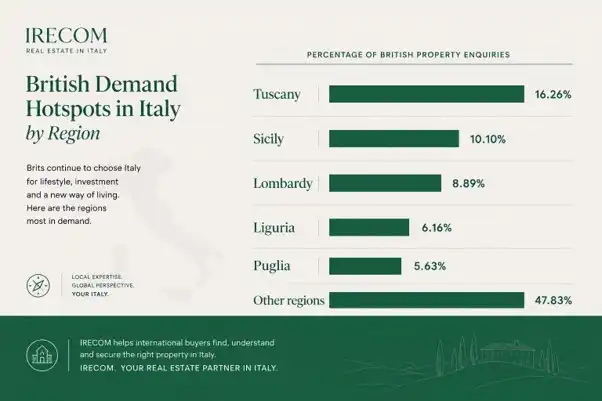
While Tuscany still dominates the international imagination and remains the leading region, Italy is no longer a single-track story. It is a fragmented market segmented by buyer motive:
- Prestige & Connectivity: Premium hubs like Milan, Lake Como, and prime Tuscan estates continue to draw high-budget buyers looking for capital preservation and premium inventory.
- Lifestyle Value: Regions like Sicily have overtaken Tuscany in sheer UK search volume growth, with buyers flocking to areas like Salento, Valle d’Itria, Monferrato, and Lunigiana.
- Renovation Plays: Budget-conscious buyers are targeting less overheated markets. While the average foreign buyer budget sat at €408,000 in mid-2025, a striking 44.89% of overseas buyers were seeking homes priced below €100,000.
Buying in Italy Without the Guesswork: How One Florence Team Is Rewriting the Rules for Foreign Buyers
The Italian dream is alive and well – but the path to owning it has never been more layered. We sat down with the people building a genuine all-in-one alternative.
There is a particular kind of frustration known only to those who have tried to buy a house in Italy from abroad. It usually begins with a photograph – a honey-stoned farmhouse above a Tuscan valley, an apartment with shutters thrown open onto a piazza in Lucca, a villa catching the last light over Umbria – and it very often ends in a tangle of emails, half-understood documents, and a growing suspicion that everyone in the transaction is working for someone other than you.
The market runs on paperwork, most of it in Italian, and the customary route asks a foreign buyer to assemble and coordinate a small army of professionals – an estate agent, a notary, a property lawyer, a tax advisor, a surveyor – and simply trust that they are all pulling in the same direction.
A Florence-based company, IRECOM (the Italian Real Estate Company), thinks that model is broken. And they are offering a full service regarding buying property in Italy.
The market: warm, tight, and full of quiet opportunity
The backdrop matters, because it explains why the way you buy has become almost as important as what you buy.
Residential prices are rising nationally, with the strongest momentum in Milan, Bologna, Rome, Florence, Naples and well-connected coastal and university markets. Foreign buyers now account for a meaningful and expanding share of activity – and in the luxury segment, the international component has grown sharply in recent years, with Knight Frank going so far as to call Italy “Europe’s tax-led magnet.”
Two features of this market reward buyers who move intelligently. The first is scarcity: the stock of homes for sale has been shrinking in the most desirable cities, and much of the best inventory never reaches a public portal at all. The second is that a great deal of value is won or lost not on the headline price, but on the diligence behind it.
“People imagine the risk in Italy is overpaying,” says Edoardo Bini, IRECOM’s cofounder and experienced property and digital operations entrepreneur. “It almost never is. The real risk is buying a property whose planning conformity is wrong, whose permitted use doesn’t match your plans, or whose documents were treated as something to fix later. That is where money quietly disappears.”
Bini is characteristically direct about what this moment offers:
“This is a selective market, not a blanket boom, and that is exactly why it favours the well-advised buyer. Prices are firm but not frenzied, credit has become cheaper, and – crucially – a large part of the most interesting stock is off-market. If you’re only looking at what’s public, you’re seeing maybe half the picture. The people who do well right now aren’t the ones who move fastest. They’re the ones who move with a full team behind them, so they can act decisively when the right thing appears and walk away calmly when the paperwork doesn’t add up. Italy rewards patience and preparation. Most buyers arrive with one and not the other. Our whole job is to supply both.”
The problem with the old way
Ask anyone who has done it: the traditional Italian purchase is a coordination problem disguised as a real estate transaction.
The estate agent, by law and by custom, is very often working for the seller. The notary is a neutral public official, not your advocate. The lawyer you find online may or may not specialise in cross-border property. The surveyor speaks a technical dialect of Italian bureaucracy. And you, the buyer, are expected to sit at the centre of this constellation, translating between them, chasing them, and hoping nothing falls through the cracks – frequently from a thousand miles away and several time zones behind.
IRECOM’s proposition is disarmingly simple: put every one of those specialists under one roof, working for the buyer, coordinated by a single point of contact who answers only to the client. The company describes it as full-service property buying – property search and negotiation, legal and tax, technical checks and renovation, all managed as one project rather than a series of disconnected transactions.
“We don’t work for the seller. We never have,” Bini says. “That single fact changes everything about how a negotiation feels.”
The legal reality nobody warns you about
If Bini supplies the commercial instinct, the legal architecture is where a purchase is genuinely made safe – and here the article’s second voice enters.
Michele Ambrogio is among the more prominent Italian lawyers working in real estate, with a practice built around exactly the cross-border transactions that catch foreign buyers off guard. He is unsentimental about where deals go wrong.
“In cross-border real estate,” he says, “value is rarely lost on the price you negotiate. It is lost when title, planning conformity and permitted use are treated as afterthoughts instead of the foundation of the deal.”
He is equally clear that Italy’s rules are not a trap so much as a system that simply expects to be respected:
“There is a persistent myth that buying in Italy is dangerous. It is not dangerous – it is specific. Italian property law is exacting about documentation, about the correspondence between what is built and what is registered, about the contractual architecture of a sale, and about the particular obligations that fall on non-residents. If you understand that in advance, the process is remarkably secure. The problems I am asked to untangle almost always trace back to a buyer who signed something before anyone had properly read it. What a structure like IRECOM’s does – and this is why I value working alongside it – is fold the legal and fiscal review into the purchase from the very first day. Due diligence stops being a box ticked near the end and becomes the thing the whole transaction is built on. That is the difference between owning an Italian home and inheriting an Italian problem.”
Ambrogio also points to the layer most buyers discover too late: the rules that apply specifically to them as foreigners – from the codice fiscale required simply to transact, to the tax treatment of rental income, to the residency and visa considerations that increasingly draw internationally mobile wealth to Italy in the first place.
“Tax and residency planning should sit beside the property search, not behind it,” he notes. “The right question is never only which house – it is which house, held how, and to what end. Answer that at the start, and you rarely have to unwind anything later.”
What it looks like in practice – and why “remote” is the quiet headline
For a British buyer, perhaps the most striking feature of the model is that it does not require you to be in Italy at all.
Viewings are carried out in person or by video on the buyer’s behalf, so a shortlist can be built without a series of transatlantic flights. And with a power of attorney in place, IRECOM says it can manage the entire process – search, negotiation, due diligence and even the final signature – while the client stays home.
“Some of our most satisfied clients have set foot in their new house for the first time as owners, holding the keys,” Bini says. “That’s only possible because the team is genuinely integrated. You cannot do that with five professionals who have never spoken to each other.”
The service does not stop at the deed, either. Renovation – planned, IRECOM insists, from day one rather than bolted on afterwards – sits within the same structure, as does the rental setup and ongoing management for those buying with income or a future resale in mind. Italian leasing has its own grammar, from the standard 4+4 residential lease to the transitory contracts used for shorter, tourist-oriented lets, and the company positions itself to handle that architecture rather than leave a new owner to decode it alone.
Beyond Florence
IRECOM’s heartland is Florence and Tuscany – including sought-after pockets such as Lucca – alongside Rome and Milan, with the rest of the country covered through a partner network. But the geography of demand is widening, and the company is candid that the “areas to watch” now stretch well beyond the postcard regions.
Tuscany’s countryside still draws foreign buyers to villas and agriturismi; Milan remains Italy’s deepest and most liquid market, buoyed by the 2026 Winter Olympics; Lake Como and the northern lakes continue to attract prime international demand; and southern regions – Puglia’s historic towns, the Ligurian coast, Sicily, Abruzzo – increasingly offer the combination of lifestyle and value that big cities cannot.
“The map is bigger than people think,” Bini says. “A buyer might arrive fixed on Chianti and leave having found something better on the coast, or in a city they’d never considered. Our job isn’t to sell them a region. It’s to understand the life they’re trying to build and then find the property – anywhere in Italy – that actually delivers it.”
The takeaway
The Italian dream, it turns out, was never the hard part. The hard part was everything between the photograph and the front door.
What IRECOM is betting on – and what the market data increasingly supports – is that in a tight, selective, opportunity-rich Italy, the decisive advantage is no longer simply finding the right house. It is having a single, aligned team that can find it, vet it, negotiate it, and hand you the keys, whether you’re standing in the piazza or watching from Britain.
“Buying property in Italy should be one of the great pleasures of a life,” Bini says. “Our entire reason for existing is to make sure it feels that way – and not like the most complicated thing you’ve ever done.”
For international buyers weighing that leap, the first conversation, both men are keen to stress, costs nothing.
The Reality of the Process
For a British buyer, the real challenge is seldom desire; it is execution. The Italian system is formal, highly document-based, and inherently safer than old stereotypes suggest.
However, many buyers misunderstand the role of the Italian notary. The notary is a neutral public official whose job is to protect the integrity of the public record, checking identity, anti-money laundering compliance, mortgages, liens, easements, and litigation exposure. Official notarial guidance indicates that the notary also verifies service charge status, cadastral conformity, certain planning elements, and fiscal regimes.
But the notary is neutral. They are not your personal strategist, nor a substitute for independent legal, fiscal, and technical advice. Mismatches between expectation and documentation-such as an out-of-date cadastral plan (the official property registry map), an unregularised layout alteration, or unpaid building service charges-can halt a sale entirely.
Furthermore, post-Brexit non-EU status introduces procedural layers. Foreign buyers require an Italian tax code (codice fiscale) from the Revenue Agency or via consular authorities. Additionally, the Ministry of Foreign Affairs dictates that non-EU or EEA nationals may need their “condition of reciprocity” confirmed on a case-by-case basis to ensure a legal right to purchase. Property ownership also does not automatically grant residency. Those looking to relocate permanently must navigate separate immigration pathways, such as the Digital Nomad Visa or the Elective Residence Visa, which requires proving sufficient passive income.
The Coordinated Approach
This complex landscape explains the rise of the all-in-one buyer-side model, pioneered by firms like IRECOM. Their Trusted Buy Property Service is structured to bring real estate, legal, tax, and technical experts under one roof. Crucially for British buyers trying to reduce travel friction, they can act remotely via power of attorney, handling everything from property sourcing and virtual viewings to the final signing at the notary.
“The overseas buyer’s real problem is not access to listings,” says property operations specialist Edoardo Bini. “It is controlling risk, reading the market properly, and moving from interest to ownership without losing momentum. If we can shortlist properly, verify properly, and negotiate properly, the buyer gets something far more valuable than convenience. They get confidence.”
On the legal side, the case for protective buyer advocacy is just as urgent.
“In Italy, the safest investment is not simply the property you like most,” adds Michele Ambrogio, founder and managing partner of Florence-based ILF Law Firm.
“It is the property whose title, planning position, tax treatment, and practical usability have been verified before the buyer becomes committed. The smartest foreign buyer is not the one who moves fastest. It is the one who knows exactly what is being bought, on what terms, and with what consequences.”
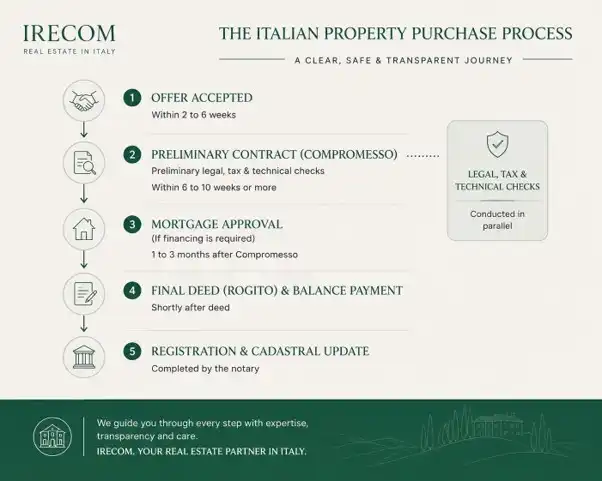
Indicative Transaction Timeline
The timeline for an overseas buyer varies depending on finance, legal status, and property health, but typically unfolds across distinct stages:
Factoring in the Real Costs
British buyers must look at transactional costs with strict realism. When buying from a private seller, the buyer generally pays a 9% registration tax based on the property’s cadastral value-though this drops to 2% if they qualify for first-home relief (prima casa). They must also pay a fixed mortgage and cadastral tax of €50 each.
If buying directly from a developer or renovator where VAT applies, the rate is typically 10% (or 4% for a primary residence), plus fixed registration, mortgage, and land registry taxes of €200 each.
Notary fees are freely negotiated but, as a loose benchmark, generally stay within 1% on a €200,000 purchase. Local estate agency commissions typically hover around 3% in official guides, though general market ranges vary between 2 and 5% plus VAT depending on the region and specific agreement.
Comparing Your Purchase Routes
To understand how these workflows intersect, it helps to map the all-in-one model against traditional paths:
| Service Component | IRECOM Trusted Buy Model | Typical Local Agency Route | Direct from Seller + Separate Advisers |
| Sourcing & Sighting | Coordinated search and remote video viewings managed by a centralized team. | Focused on proprietary local listings; strongest on regional negotiations. | No brokerage fees, but the buyer must find properties and arrange visits independently. |
| Due Diligence | Comprehensive legal, tax, and structural checks integrated into the package. | Legally limited. Agents generally rely on seller-supplied property data. | Potentially thorough, but the buyer must independently source and manage a surveyor, lawyer, and accountant. |
| Remote Execution | Full power of attorney capabilities to complete the transaction from abroad. | Not standard. Buyers usually need to travel for key milestones. | Possible, but the buyer must personally manage cross-border legalisation, translation, and courier logistics. |
| Immigration & Tax Support | In-house assistance with codice fiscale, tax optimization, and visa pathways. | Exceptionally rare. Most traditional agencies do not handle immigration law. | Requires hiring a dedicated immigration lawyer or relocation specialist. |
| Post-Deed Handover | Continued oversight options, including property management and maintenance. | Concludes at closing unless the agency has an independent lettings division. | Entirely dependent on separately contracted local handymen or property managers. |
Comments on this guide to Dream Holidays: How to Find the Perfect Luxury Property article are welcome.
Italy Architectural Designs
Italian Architecture Designs – chronological list
++
Italian Properties
Buying a house in Italy? Property guide
Foreigner’s guide to buying property in Italy
Italian architecture travel and experience design
How to Find the Perfect Luxury Property in Italy

Comments / photos for the IRECOM Italian Real Estate Company Luxury Property page welcome.