Why Some Bathroom Mirrors Make a Bathroom Feel Bigger Than It Really Is
24 July 2026
Most homeowners assume that making a bathroom feel bigger means knocking through a wall or spending thousands on a full renovation. It’s an understandable assumption, since space seems like a fixed thing. Either you have it or you don’t.
But one of the most effective design tools rarely involves any structural work at all. It’s the mirror.
Some bathroom mirrors genuinely transform a room, bouncing light around and making the whole space feel calmer and more open. Others do the opposite. A badly placed or undersized mirror can make even a well-proportioned bathroom feel boxed in. The difference comes down to a handful of decisions most people never consciously notice, even though they feel the effect every time they walk in.
Why Perceived Space Matters More Than Actual Space
Two bathrooms can share identical dimensions and feel completely different to stand in. The square footage hasn’t changed. What’s changed is visual openness: how far the eye travels before hitting a solid surface.
If the first thing you see on opening the door is a blank wall a metre away, the brain reads the room as small. If the eye is drawn across a reflective surface that extends the view, the brain reads it as larger. This is why a Victorian terrace bathroom in Manchester, often under six square metres, can feel surprisingly spacious with the right mirror, while a larger new-build en-suite can feel oddly closed in under poor lighting.
How Mirrors Influence the Way We Experience a Bathroom
Mirrors affect perceived space through reflected light, reflected space, and visual balance. A mirror positioned to catch daylight or a well-placed light fitting bounces that light back into the room rather than letting it stop at one wall. This matters more in bathrooms than almost anywhere else, since UK bathrooms are often the darkest room in the house.
A mirror also reflects the room itself, effectively doubling its visual depth. A bathroom 2.4 metres deep can register as nearly twice that with a well-placed mirror reflecting the opposite wall. And a mirror well-proportioned to its wall and the furniture beneath it creates a sense of order that asymmetrical or undersized mirrors don’t.
Why Larger Mirrors Often Make Bathrooms Feel More Spacious
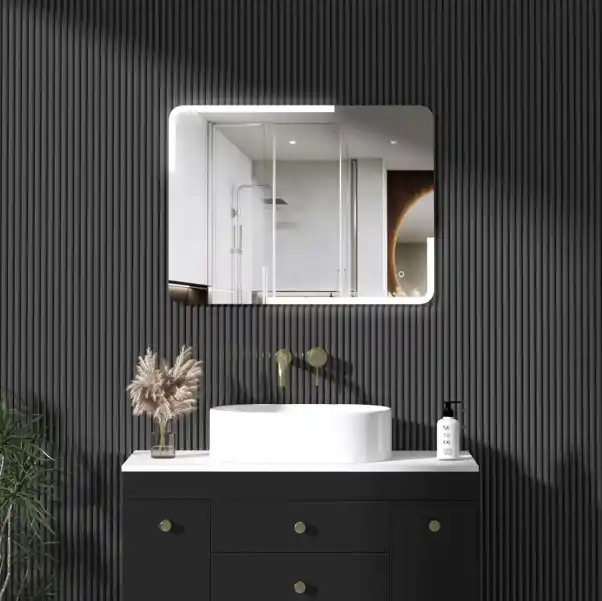
A larger mirror tends to outperform a smaller one because it creates an uninterrupted reflection, rather than a fragment of the room. A mirror spanning most of a vanity unit’s width extends the visual width of that wall, which helps in narrow bathrooms where width is usually the most constrained dimension.
Frameless mirrors support this particularly well, since the lack of a visible border lets the glass blend into the wall rather than competing with it. That said, bigger isn’t always better. In a small cloakroom, an oversized mirror can look disproportionate. Illuminated mirrors offer a good middle ground here, since the light itself adds presence and brightness without needing an oversized sheet of glass.
Why Mirror Shape Matters More Than Most Homeowners Realise
Round Mirrors
Round mirrors soften a room. With no hard corners to create stopping points, the eye moves continuously around the shape, which works well against a lot of straight lines and tiling.
Oval Mirrors
Oval mirrors share that softness but add height. A tall, narrow oval draws the eye upward, helping a low-ceilinged bathroom feel taller.
Capsule Mirrors
Capsule mirrors, an elongated oval with flatter sides, suit contemporary bathrooms with clean lines, emphasising vertical space.
Rectangle Mirrors
Rectangle mirrors remain the most versatile choice. A wide rectangular mirror placed horizontally expands the perceived width of a wall, which suits narrow bathrooms well.
Arched Mirrors
Arched mirrors bring architectural character. The curved top draws the eye upward in a more structured way than an oval, suiting period properties where a hard rectangular edge can feel clinical.
Octagon and Hexagon Mirrors
These work best as feature pieces. Their irregular edges break up reflected light less efficiently than a round or rectangular shape, so they suit a secondary role rather than the main tool for expanding a small room.
How Illuminated Mirrors Can Make a Bathroom Feel Brighter
Lighting and perceived space are closely linked. Integrated lighting in illuminated mirrors reduces shadows around the face and surrounding wall, helping the whole room read as brighter and more evenly lit, rather than relying on one bright spot from a single ceiling downlight. Uneven lighting makes a room feel chaotic and smaller; balanced illumination feels calmer and more open.
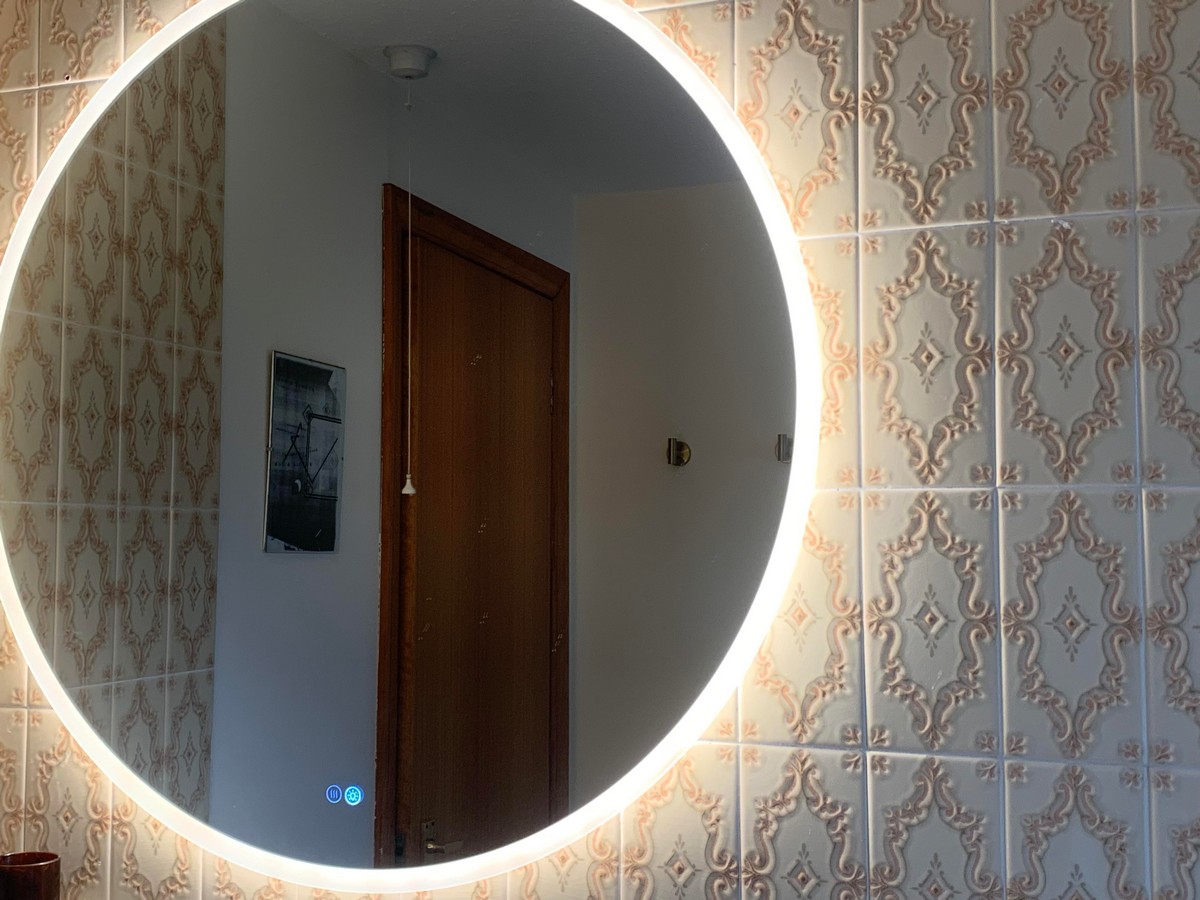
Back-lit mirrors and front-lit mirrors achieve this differently. Back-lit mirrors radiate light from behind the glass, creating a soft halo against the wall, suiting bathrooms where the mirror is more of a feature. Front-lit mirrors direct light forward, which is generally more practical for grooming tasks, since light falls directly on the face. For UK bathrooms without natural light, integrated lighting is often the single biggest improvement available without any rewiring beyond the mirror itself.
Framed vs Frameless Mirrors: Which Creates More Visual Space?
Frameless mirrors tend to create more visual space, since there’s no visible boundary interrupting the reflection. This suits minimalist or smaller bathrooms, where every visual break matters.
Framed mirrors aren’t automatically worse, though. A slim frame in chrome or brushed brass can define the mirror as a deliberate feature, which works well in larger bathrooms with room to absorb a stronger visual element. A black frame offers bolder contrast for contemporary or industrial-style spaces, though a thick black frame can shrink the visible reflection more than expected. As a general rule, the more constrained the space, the more a frameless or slim-framed mirror helps.
The Importance of Mirror Placement
Placement often matters more than the mirror itself. Above the vanity unit is the obvious default, sitting at natural eye level and working with task lighting. But a mirror hung opposite a window, where one exists, captures and redistributes natural daylight, brightening a windowless or north-facing bathroom even where obscured glazing protects privacy.
Wall positioning matters too. A mirror centred on the longest unbroken wall does more to expand the room than one tucked into a corner or interrupted by cabinetry. In many small UK bathrooms, simply repositioning an existing mirror to a better wall has more impact than buying a larger one.
How Bathroom Furniture Influences Mirror Effectiveness
A mirror works in relation to the furniture around it. Wall hung vanity units pair well with larger or frameless mirrors, since the visible floor space beneath already creates openness that a generous mirror reinforces. Floor standing vanity units feel more substantial, so they often suit a mirror with a bit more presence, such as a framed or illuminated design, to balance that visual weight.
Cloakroom vanity units, given their limited space, benefit from mirrors that prioritise height over width, such as oval or capsule shapes, to avoid overwhelming a narrow wall. Modern bathroom furniture and the mirror above it should be chosen together. A mirror too large or heavily styled for a delicate vanity unit looks mismatched, just as an understated mirror can get lost above a bold one.
Common Bathroom Mirror Mistakes That Make Rooms Feel Smaller
Undersized mirrors are the most common mistake. A mirror noticeably narrower than the vanity unit beneath it looks unbalanced and reflects far less of the room than it could. As a rough guide, a mirror should sit close to the width of the unit, not significantly smaller.
Poor placement is another frequent issue, particularly mirrors hung too high or low, or positioned to reflect a wall rather than the room’s main sightline. Excessive framing can also work against the room, especially thick or ornate frames in small bathrooms, where the frame eats into the available reflection. Blocked reflections, where a light fitting or shelving partially obscures the mirror, lose much of the intended effect. And poor lighting choices, particularly relying on a single overhead downlight, leave shadows that work against an open, airy feel.
The fix is usually straightforward: size the mirror to the vanity unit, position it along the room’s main sightline, keep framing proportionate, and consider an illuminated option where the room lacks natural light.
What Actually Makes a Bathroom Feel Bigger?
The elements that genuinely affect perceived space are mirror size, shape, placement, lighting, room layout, and furniture proportions. Size should be proportionate to the wall and vanity unit, not simply as large as possible. Shape should suit the room’s dimensions, favouring height-enhancing shapes like oval or arched mirrors in low-ceilinged rooms, and width-expanding rectangles in narrow ones.
Placement should prioritise natural sightlines and any available daylight, rather than defaulting to dead centre out of habit. Lighting, particularly through illuminated mirrors, can compensate for limited natural light. And furniture proportions need to work with the mirror, not against it, so the whole wall reads as considered rather than assembled piecemeal. None of this requires extra square metres. It requires a clearer understanding of how a mirror actually behaves within a room.
Final Thoughts
Creating a bathroom that feels spacious isn’t always about gaining extra square footage. It’s about how effectively the room uses what it already has, and the mirror is one of the most powerful tools available for doing exactly that.
The right size, shape, placement, and lighting can transform how a bathroom feels to stand in, often more dramatically than people expect from a single fixture. Whether that means choosing a frameless mirror to maximise an uninterrupted reflection, an illuminated mirror to brighten a windowless room, or simply repositioning an existing mirror to catch better light, the principle stays the same. A bathroom mirror isn’t just there to check your reflection. Chosen and placed well, it changes the entire feel of the room around it.
Comments on this guide to Why some bathroom mirrors make a bathroom feel bigger article are welcome.
Bathroom Mirrors – Interior Architecture Design
Mirror Posts
Top 10 LED mirror designs to transform your bathroom
How to hang a frameless mirror on a wall
How vanity mirrors add beauty and function at home
Reflections in the architecture of makeup mirrors
+++
Building Articles
Comments / photos for the Why some bathroom mirrors make a bathroom feel bigger advice page welcome