How to Get a New Water Connection as a Developer: Who Does What
10 June 2026
Every development needs a water supply, and the new connection is one of those items that looks simple on the programme until it starts slipping. The process involves at least two parties, sometimes three, a legal framework most project managers have never read, and a sequence of dependencies where one incomplete form can cost a month. This guide sets out the process as it works in England: the legal routes available, who is responsible for each stage, where an accredited contractor fits, and the points where programmes most often lose time.
The legal framework: two routes to a supply
New water connections in England sit under the Water Industry Act 1991, and broadly there are two routes, depending on what the site needs.
For a single property or a small scheme close to an existing main, the route is a service connection: a new supply pipe connecting the premises to the existing network. For larger developments where the existing network cannot serve the site, the developer can requisition a new water main, requiring the water company to extend its network, with the developer contributing to the cost under the charging rules that apply at the time.
There is also a third option that has reshaped the market over the past two decades: self-lay, where an accredited provider installs the new mains and services instead of the water company, and the completed assets are adopted into the public network afterwards. Ofwat, the industry regulator, oversees the framework that gives developers this choice. Which route suits a given scheme is a genuine programme decision, and it is worth making early, because the routes carry different timescales, costs, and procurement implications.
Step one: the application goes to the water company
Whichever route is taken, the process starts with the water company. The developer, or an agent acting for them, submits an application to the developer services team of the statutory water undertaker for the area. This is a legal point as much as a procedural one: the water company owns the network, and nothing connects to it without their assessment and approval. Most companies publish their process in full; Thames Water’s new connection guidance is a typical example of what the application route looks like in practice.
The application pack matters more than most people expect. It typically needs site location and layout plans, the proposed point of connection, the number and type of supplies, intended water use, and details of anything unusual about the site, such as contaminated ground, which can trigger barrier pipe requirements and additional assessment. Incomplete applications are the single most common cause of early delay, because they go to the back of the queue rather than being corrected in place.
Step two: assessment, quotation, and permits
The water company assesses the application against network capacity, may carry out a site visit, and issues a quotation with technical conditions attached. Timescales for this stage vary between companies, and quoted delivery windows change as workloads and permitting requirements shift, so always check the current published levels of service for the undertaker covering your site rather than relying on figures from older guides.
If the connection requires excavation in the public highway, there is a second consenting layer that sits outside the water company’s control entirely: street works permits from the highway authority, with traffic management, embargo periods, and sometimes road closures attached. This is where connection programmes most often lose weeks, because permit lead times stack on top of the water company’s own programme rather than running in parallel. A connection quoted at a few weeks of work can sit behind months of permitting on a busy road.
Step three: the installation, and where a contractor fits
Once the quote is accepted and paid, the physical work begins, and this is where developers have more choice than many realise. The works split into what the industry calls contestable and non-contestable elements: parts that an accredited third party is permitted to deliver, and parts the water company reserves for itself, with the final live connection almost always in the second category.
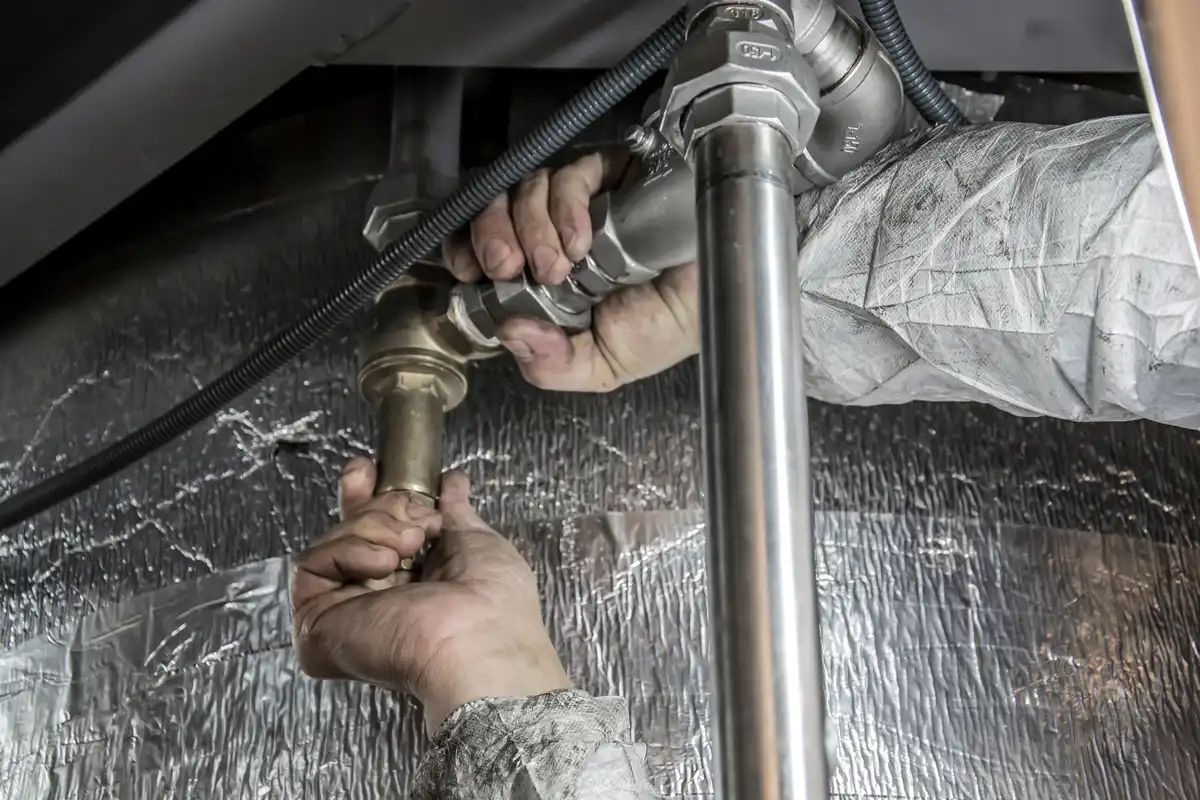
For the private side of the connection, the pipework within the site boundary, the developer appoints their own contractor. That contractor excavates, lays the supply pipework to the water company’s specification, and prepares the connection point for inspection. Getting this right first time matters, because the inspection failures that force re-excavation are nearly always the same handful of issues: insufficient depth of cover, incorrect bedding and surround material, missing marker tape, or pipework that has not been pressure tested and disinfected to the standard the inspector is checking against.
Experienced water infrastructure contractors handle this end to end. McFadden Utilities, a family-run Hertfordshire contractor that has worked on water networks for over 40 years, delivers new water connections for developers and private clients across the South East, covering the excavation, pipework, testing, and reinstatement, and assisting the client through the water company’s process from the point of application onwards. Contractors of this type cannot submit the application for you, since first contact sits with the customer and the water company, but a contractor who knows the process, and knows what the inspectors look for, removes most of the friction from it.
For larger schemes taking the self-lay route, the provider must be accredited under the Water Industry Registration Scheme (WIRS), and every legitimate self-lay provider appears on the WIRS register administered by LRQA, which is also where a developer can verify exactly what scope of work a provider is accredited to deliver. Water companies publish their own self-lay processes through their developer services pages; Affinity Water’s self-lay guidance is the relevant example for much of Hertfordshire and the surrounding area.
Step four: the final connection and adoption
Whichever route is taken, the final connection to the live main is made or approved by the water company, following inspection of the completed works. Once connected and commissioned, the supply is live. On self-lay schemes there is one further stage: adoption, where the newly laid mains and services formally transfer to the water company, which then owns and maintains them as part of the public network. A provider with a clean adoption record is a provider whose work the water company has repeatedly signed off, which is one of the more reliable quality signals available when shortlisting.

The takeaways
Three things separate the developments where water connections run smoothly from the ones where they slip. First, apply early and decide the route early, because the application, assessment, and permitting stages carry lead times the developer cannot compress, and the self-lay decision changes the procurement. Second, assemble a complete application pack, because incomplete submissions restart the clock. Third, appoint a contractor who has done this many times before, knows the specifications the inspectors are checking against, and can carry out the trenching, pipework, testing, and reinstatement as one package.
The water connection will never be the glamorous part of a development. Handled properly, it should never be the part anyone remembers either.
Comments on this Full Guide on How to get a new water connection as a developer article are welcome.
Household Water Articles

Water Posts
The Many Ways to Treat Household Water
What you should do after your house floods
6 Ways to Detect Water Leak in Your Home
++
Residential Property Posts
Comments / photos for the How to get a new water connection as a developer advice guide page welcome