How Businesses Can Reduce Risk When Choosing a New Office
15 July 2026
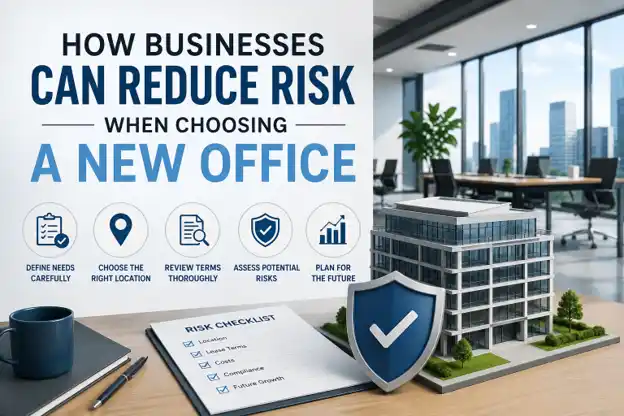
What Every Business Should Check Before Renting Office Space
One of the risky business decisions that continues to affect expenses, operations, and employee satisfaction on a daily basis is choosing an office space for your team. Many businesses spend more time haggling over the headline rent but spend far less time checking whether the workspace will still make commercial sense once team growth, hybrid attendance, fit-out, meeting-room demand, commute patterns, contract terms, and operating costs are taken into account.
The shift towards flexible office space reflects that concern. CBRE’s 2025 Americas Office Occupier Sentiment Survey found that 60% of organisations use flexible office space to reduce capital expenditure, while 42% use it to manage uncertain future demand. Clearly, there is a broader change in how businesses evaluate office space not simply as a place to work, but as an operational investment that should support growth, control costs, and adapt as business needs evolve.
In this guide, we’ll walk through practical checks to help reduce office rental risk before you commit to a new office.
Start with Business Requirements, Not Property Listings
Define your business needs before looking at properties to avoid common rental mistakes that arise when you prioritise listings over your actual requirements.
❖ Assess How Your Team Uses Office Space
Examine attendance trends, collaboration requirements, meeting frequency, client visits, storage, specialised equipment, and anticipated hiring over the next two to three years, rather than determining desks per employee. These factors determine how efficiently an office supports day-to-day operations.
❖ Separate Essential Requirements from Nice-to-Have Features
By prioritizing operational requirements, businesses can avoid paying for non-productive luxuries while ensuring they don’t overlook the essential features they rely on daily.
Calculate the Real Cost of an Office, Not Just the Rent
Advertised rent rarely reflects the full financial commitment.
❖ Compare Total Occupancy Costs
Calculate every recurring expense, including utilities, internet, furniture, meeting room charges, maintenance, parking, service charges, and any fit-out investment. Comparing monthly rent alone is not nearly as accurate as comparing overall occupancy costs.
❖ Consider Upfront Fit-Out and Future Adaptation Costs
JLL’s Global Office Fit-Out Cost Guide highlights continued cost pressures across office projects, with organisations increasingly prioritising higher-quality, performance-focused workplaces that maximise long-term value. Factoring these costs into the initial decision helps avoid unexpected capital expenditure later.
Review Lease Flexibility Before Signing
Office rental risk often comes from contract terms rather than the workspace itself.
❖ Understand How Easily the Agreement Can Adapt
Review notice periods, break clauses, renewal rights, assignment options, expansion provisions, and early termination conditions. These determine whether the agreement can adapt if business priorities change before the contract ends.
❖ Decide Whether Flexible Offices Better Match Your Growth Plans
Businesses facing recruitment uncertainty, project-based demand, or growth into new markets can reduce office leasing risk by using flexible offices rather than committing to long fixed-term agreements. Instead of assuming that longer leases necessarily yield more value, the goal is to align the lease structure with your business plan.
Evaluate Whether the Building Will Support Daily Operations
Move beyond aesthetics and assess operational performance.
❖ Check the Infrastructure That Keeps Your Business Running
Assess the reliability of internet, power, and ventilation systems. Confirm that access control, security, and meeting facilities meet your operational needs, ensuring you prioritize these practical requirements over aesthetic design.
❖ Judge the Location by Business Efficiency
Examine average commute times, transportation dependability, client accessibility, local business services, and staff convenience instead of focusing on whether an address appears prestigious. Travel is greater than one destination.
Complete Your Due Diligence Before Making a Commitment
Final verification reduces avoidable risk.
❖ Visit the Office More Than Once
Marketing viewings rarely reflect day-to-day conditions. You should inspect the building at different times of day (especially on Tuesday, the busiest day of the week!) to observe occupancy levels, noise, shared facilities, security, and how the workspace operates during normal business hours.
❖ Compare Multiple Office Space Options Before Deciding
Don’t evaluate just one property at a time. Weak proposals are easier to spot when several office space options are compared across occupancy costs, lease flexibility, operational fit, and future scalability.
❖ Review Exit Obligations Before You Move in
Many companies give more attention to you at the beginning of an agreement than to its conclusion. Examine the procedures for reinstatement, notification, deposits, repairs, and any ongoing financial obligations after leaving the office.
Tips to Choose the Right Office Space for Your Business
- To avoid paying for services your company doesn’t truly need, identify your operating needs before looking at office space.
- To ensure that the office can accommodate anticipated recruiting, restructuring, or hybrid working changes, project your personnel needs at least two years in advance.
- Include utilities, service fees, furnishings, fit-out costs, parking, and maintenance in your calculation of overall occupancy costs, not just the monthly rent.
- Before making a choice, evaluate a number of office space options side by side to compare lease terms, flexibility, included services, and overall value.
- To reduce the risk associated with office rentals in the event that your company’s circumstances change, carefully review break terms, notice periods, and leave requirements.
- Instead of making a long-term commitment too soon, choose flexible offices if your expansion goals or personnel size are still unknown.
- Visit the facility at different times of the day to examine noise levels, occupancy, security, shared facilities, and the overall working environment.
- Before signing, check the building’s infrastructure, including the availability of meeting rooms, air conditioning, power resilience, and internet dependability.
- Consider client accessibility and employee commutes while evaluating the location rather than just the business address’s prominence.
- Make sure your workplace promotes productivity, future growth, and operational efficiency by treating it as a long-term business investment rather than a temporary outlay.

Conclusion
The office that continues to serve your business as it expands, changes, and adapts is the one that poses the least risk; it is rarely the cheapest or the newest. Businesses should avoid costly commitments that are hard to reverse by evaluating office space based on operational requirements, overall occupancy expenses, lease flexibility, and long-term scalability.
Choosing an office is easier when decisions are based on objective comparisons rather than assumptions. Office Hub helps businesses assess flexible offices against practical operational and commercial requirements, making it easier to reduce office rental risk before signing an agreement.
Comments on this guide to How businesses can reduce risk when choosing a new office work environment article are welcome.
Office Building Design

image source : pexels.com
Office Buildings Interior Design Posts
Modular wall systems in commercial office design
Accessibility, wellness and modern commercial spaces evolution
Steel structure office buildings interior design

++
Building Articles
Architecture
Comments / photos for the How businesses can reduce risk when choosing a new office advice page welcome