
Circadian rhythm travel: Realigning your body clock with the Mediterranean sun
4 June 2026
Long flights leave more than tired legs. They scramble the internal clock that governs sleep, appetite, mood, and alertness. Most travellers need roughly one day of recovery for each time zone crossed, and a large shift can take up to two weeks to settle.
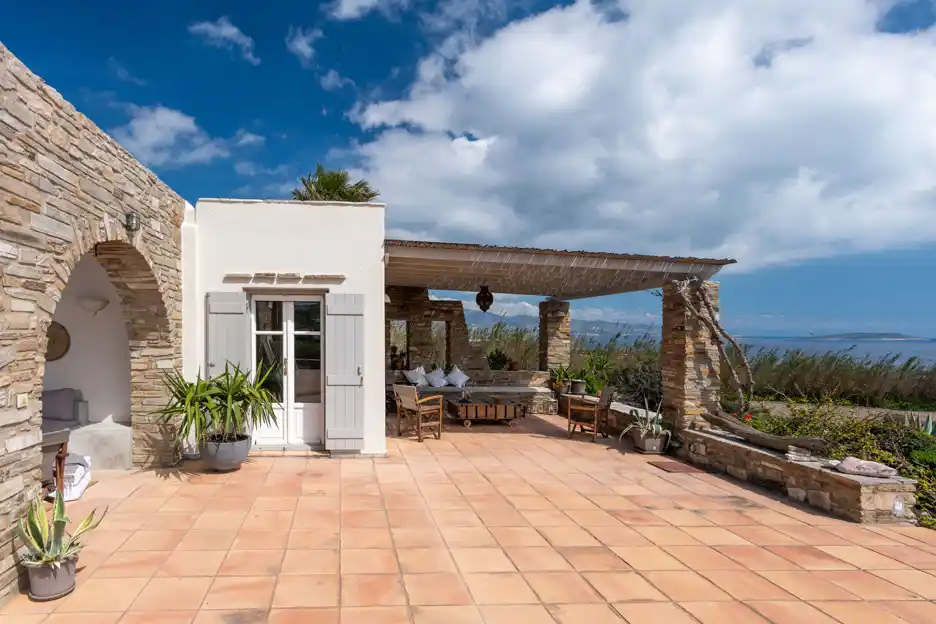
Light is the strongest signal your body uses to find local time again, which is why where you stay matters as much as when you sleep. A holiday base such as the oliaros villa in Soros beach Antiparos, set along the island’s eastern coast, places that first burst of morning sun within easy reach. Here is how to use the Mediterranean day to reset faster.
Key Takeaways
- Light is the body’s main timing cue, and morning light shifts the clock earlier.
- Expect about one day of adjustment for each time zone you cross.
- East-facing rooms and open terraces deliver daylight soon after waking.
- Dim, warm light in the evening protects melatonin and supports sleep.
- Home orientation and glazing shape how well a space keeps you in rhythm.
Why your body clock drifts when you travel
Almost every cell carries a small clock, and a region of the brain called the suprachiasmatic nucleus keeps them coordinated across a 24-hour cycle. This system decides when you feel sleepy, when hunger arrives, and when energy peaks.
Travel breaks the link between that internal timing and the clock on the wall. The resulting circadian misalignment brings broken sleep, daytime fog, and digestive upset.
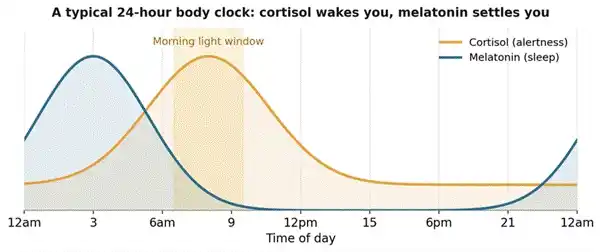
Chart: a typical 24-hour body clock, with cortisol rising through the morning and melatonin climbing at night.
Dr. Nathaniel Watson, a sleep specialist and neurology professor at the University of Washington, describes morning light as the single most powerful cue for setting this clock. Get the timing right and the body realigns sooner.
How Mediterranean light does the heavy lifting
Bright daylight in the first hour after waking pushes the clock earlier, a shift researchers call a phase advance. Aim for 15 to 20 minutes outdoors soon after rising, without sunglasses where that feels comfortable.
Flying east usually rewards morning exposure, while westward journeys settle better with late-afternoon sun. The direction of your trip changes the plan, so match the light to the way you are travelling.
Match the light to your direction
| Travel direction | Seek light | Limit light |
| Flying east (Americas to Greece) | Early morning | Late evening |
| Flying west (Greece to Americas) | Late afternoon | Early morning |
| No time change | Morning, after waking | Two hours before bed |
Dr. Jamie Zeitzer of Stanford University points out that the body reads brightness as a relative signal, so steady timing matters more than chasing the strongest hour of the day.
This short talk from a Salk Institute researcher explains how daily light and meal timing keep the body’s many clocks in sync. Watch it here: youtube.com/watch?v=fciGNBN0nKM.
Designing a stay around the sun
Architecture decides how much of that daylight actually reaches you. Orientation, window placement, and shading govern the strength and timing of light indoors, the same thinking behind good daylighting strategy.
Image suggestion 3: Whitewashed Cycladic architecture against the Aegean. Source: https://pixabay.com/photos/santorini-panorama-greece-cyclades-1193671/ . Placement: within this section, above the paragraph on Cycladic walls.
East-facing bedrooms and open terraces catch the sunrise, handing you a clean waking signal before the day fills up. Whitewashed Cycladic walls bounce brightness deep into rooms, while pergolas and broad eaves soften the harsh midday glare.
Many contemporary Greek homes are planned around this play of light and shade. Restored island houses such as the Patitiri House and the nearby Tetris House show how local builders work with the sun rather than against it.
A sun-drenched terrace facing the eastern sea, like the one at the villa above, turns your first coffee into a daily dose of natural medicine.
Frequently asked questions
How long does jet lag last?
Recovery usually runs about one day for each time zone crossed, so a six-hour shift can take roughly six days. Larger jumps may need up to two weeks of well-timed light and steady sleep.
Is morning or evening light better?
It depends on direction. Heading east, seek morning light to move your clock earlier. Heading west, favour late-afternoon light to push it later, and keep evenings dim either way.
Can I reset my clock without direct sun?
Yes, although sunlight works fastest. A bright outdoor sky still helps on cloudy days, and a 10,000-lux light box is a useful backup when natural daylight runs short.
Does room orientation really affect sleep?
It can. East-facing rooms supply early light that supports waking, while blackout blinds for the evening protect melatonin. Thoughtful shading also prevents the overheating that disturbs rest.
How much morning light do I need?
Most guidance suggests 15 to 20 minutes of outdoor light within an hour of waking. Brighter and longer exposure helps more, especially after a long flight heading east.
Travelling back into rhythm
A change of place need not mean days of fog. Treat light as your main tool, lean on the early Mediterranean sun, and let the building around you carry that signal indoors.
Plan the first morning outside, keep evenings soft, and your body clock tends to follow. The payoff is a holiday that feels restful from the very first day.
References
Sleep Foundation. Light and Sleep: Effects on Sleep Quality. https://www.sleepfoundation.org/bedroom-environment/light-and-sleep
Harvard Health Publishing. Resetting your circadian clock to minimize jet lag. https://www.health.harvard.edu/blog/resetting-your-circadian-clock-to-minimize-jet-lag-2016090810279
CDC NIOSH. Effects of Light on Circadian Rhythms. https://www.cdc.gov/niosh/work-hour-training-for-nurses/longhours/mod2/19.html
Wu Tsai Human Performance Alliance. Beating Jet Lag: A Guide to Strategic Light Exposure. https://humanperformancealliance.org/playbook/beating-jet-lag-a-guide-to-strategic-light-exposure/
Comments on this guide to Realigning your body clock with the Mediterranean sun – Circadian rhythm travel article are welcome.
Greek Architecture
Greek Architecture Designs – chronological list

++
Athens Buildings
Comments for the Circadian rhythm travel: Realigning your body clock with the Mediterranean sun page welcome.


