Cloudhaus Hotel Yunlin Resort, China
Architects: RooMoo
Location: Yunlin Resort Area, northern slope of Jinfo Mountain, Nanchuan District, Chongqing, Southwestern China

Photos by Wen Studio
Process photos by RooMoo
5 November 2025
PROJECT BRIEF
The Cloudhaus Hotel is located at 1200 meters height on the northern slope of Jinfo Mountain in Nanchuan District, Chongqing, China. Built initially as a sales office for a residential resort, the client now aims to sustainably transform the 5-level building into a boutique B&B hotel with 24 rooms, highlighting local mountain characteristics. The design begins with the mountain field and, through in-depth local exploration, transforms the natural context and humanistic traces into a unique spatial narrative and experience.
Community in the mountains
Local transformation of local culture
The mountain, both a venue and a proposition. We go deep into it, find answers, and shape the future of mountain habitats. Instead of relying solely on concepts, experiences, and online research, we planned most of our conceptual design time to exploring the mountains for locally available materials and resources to respect the local environment.
Retention and growth – optimal management of the main structure of the building
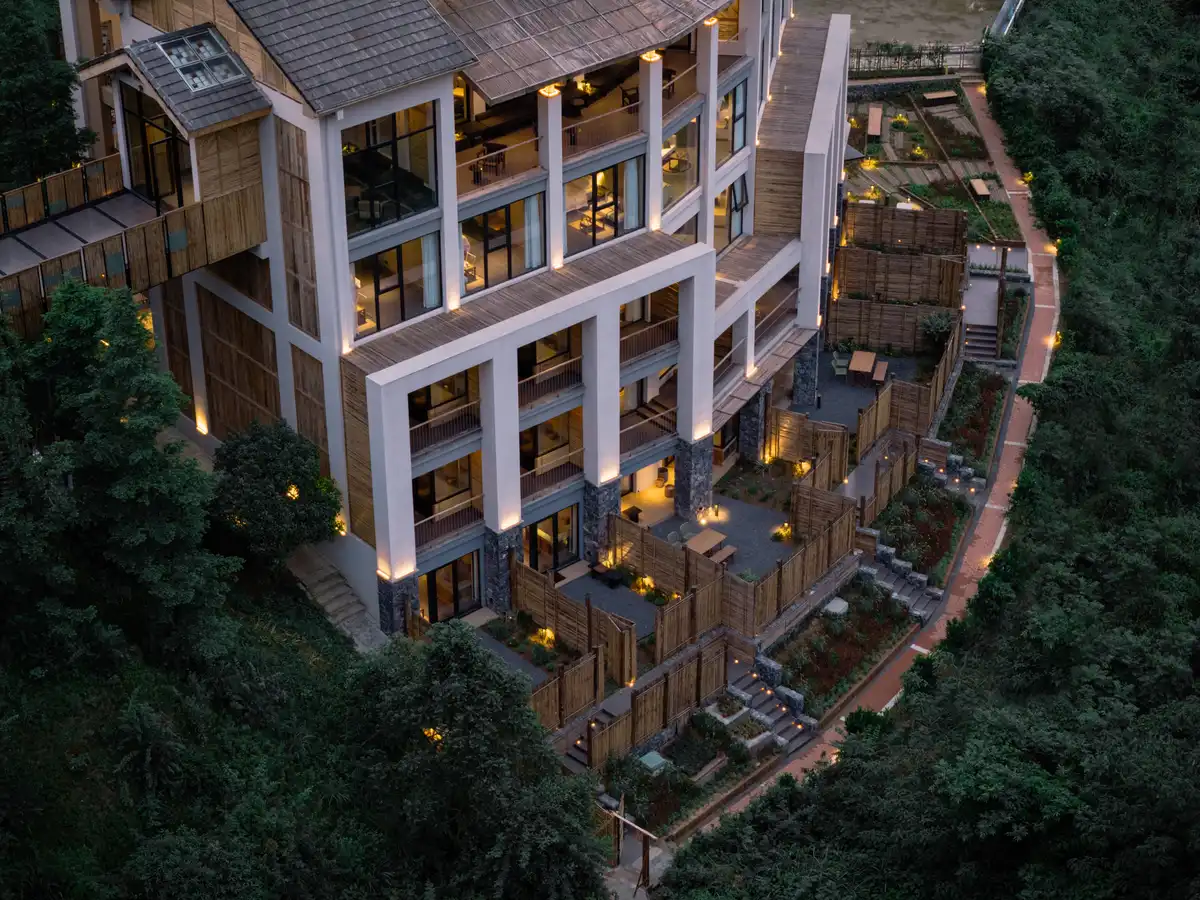
As we transformed the main building facade, we drew inspiration from the mountains and forests. We integrated local cultural construction methods and language characteristics into a design that features both frames and the spaces between them. This approach allowed us to reorganize the visual system of the original building, ensuring that it meets the functional requirements of a hotel while achieving a harmonious balance of aesthetics and scale.
The main façade features eight cantilevered white structures extending vertically, highlighting the mountain’s natural slope and defining room elevations. Locally sourced bamboo panels and stone slabs create a horizontal visual connection to the landscape.
At the top level, the balcony honors the original style while incorporating typical Western Sichuan eaves. A striking glass curtain wall is the centerpiece, with a wooden framework extending symmetrically to the terrace, forming a semi-open ecological canopy that provides shelter from rain and serves as a stunning focal point of the building.
The entrance landscape square
The front landscape square is situated close to the winding mountain road. To maintain the area’s boundaries, we utilized the original bricks from the ground to address structural issues with the bridge and the sinking of the front landscape square. Additionally, we incorporated gravel and dragon scale stone sourced from the mountain to create a central landscape feature that faces both entrances and the hotel’s main doorway. Additionally, we selected recycled wood with imperfect surfaces for carbonization, maximizing the use of recycled timber. And combined this with concrete core waste from the building renovation to develop a physical and visual partition system for the front landscape square.
In consideration of the local construction techniques for bamboo railings, we utilized green plastic woven tapes and bamboo strips that are readily available for purchase in the area to build the railings at the side of the mountain and the entrance bridge of the hotel. By adjusting the weaving pattern of the green woven sections to enhance the visual rhythm as guests enter the hotel.
The courtyard room yard partition on the second floor, which connects to the ground, employs a strategy of recycling logs and materials. It retains the original shape and height of the logs as much as possible, using bamboo to create a natural, organic, and relaxing wall system that gradually tapers with the terrain. This design complements the bamboo filling materials and mountain stone pieces situated between the facade frames, resulting in a cohesive visual language.
From the mountain to physical space – the reception floor
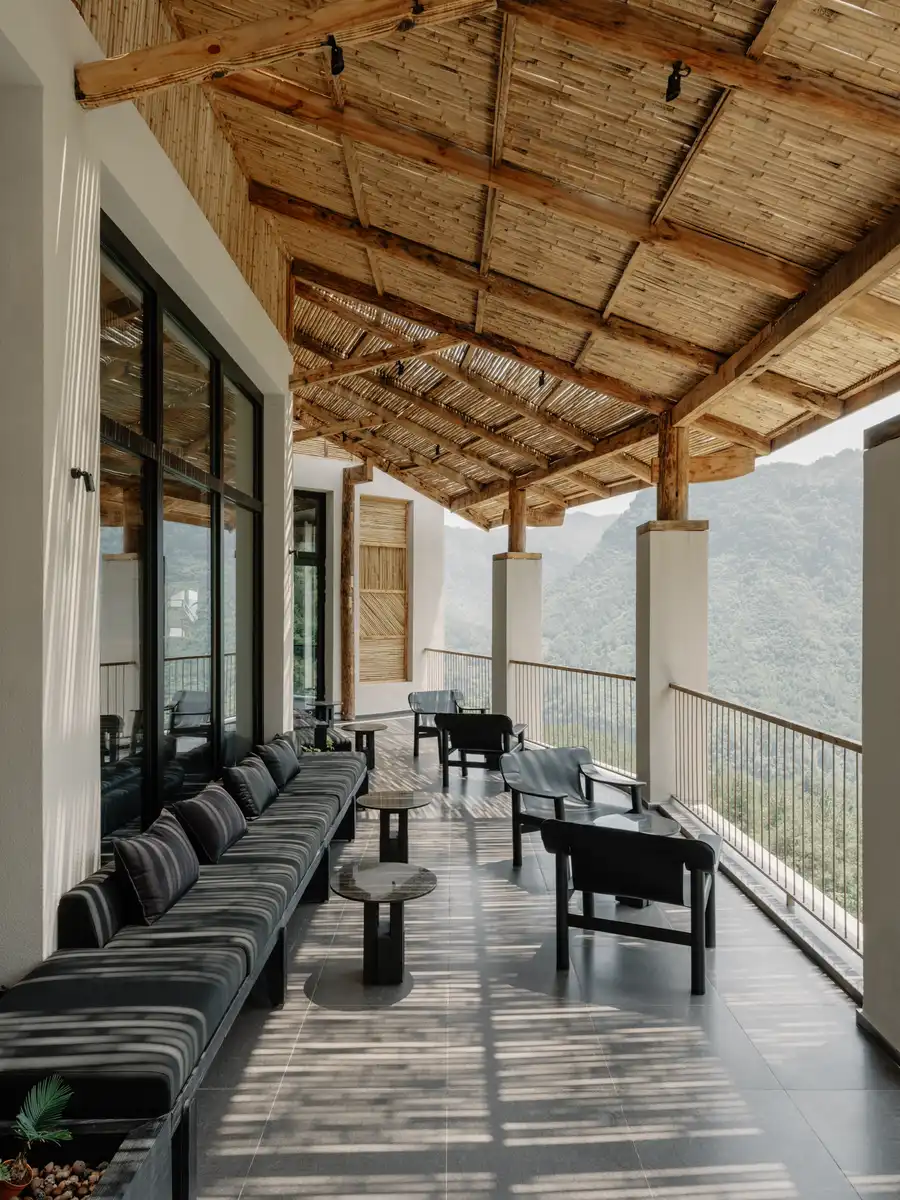
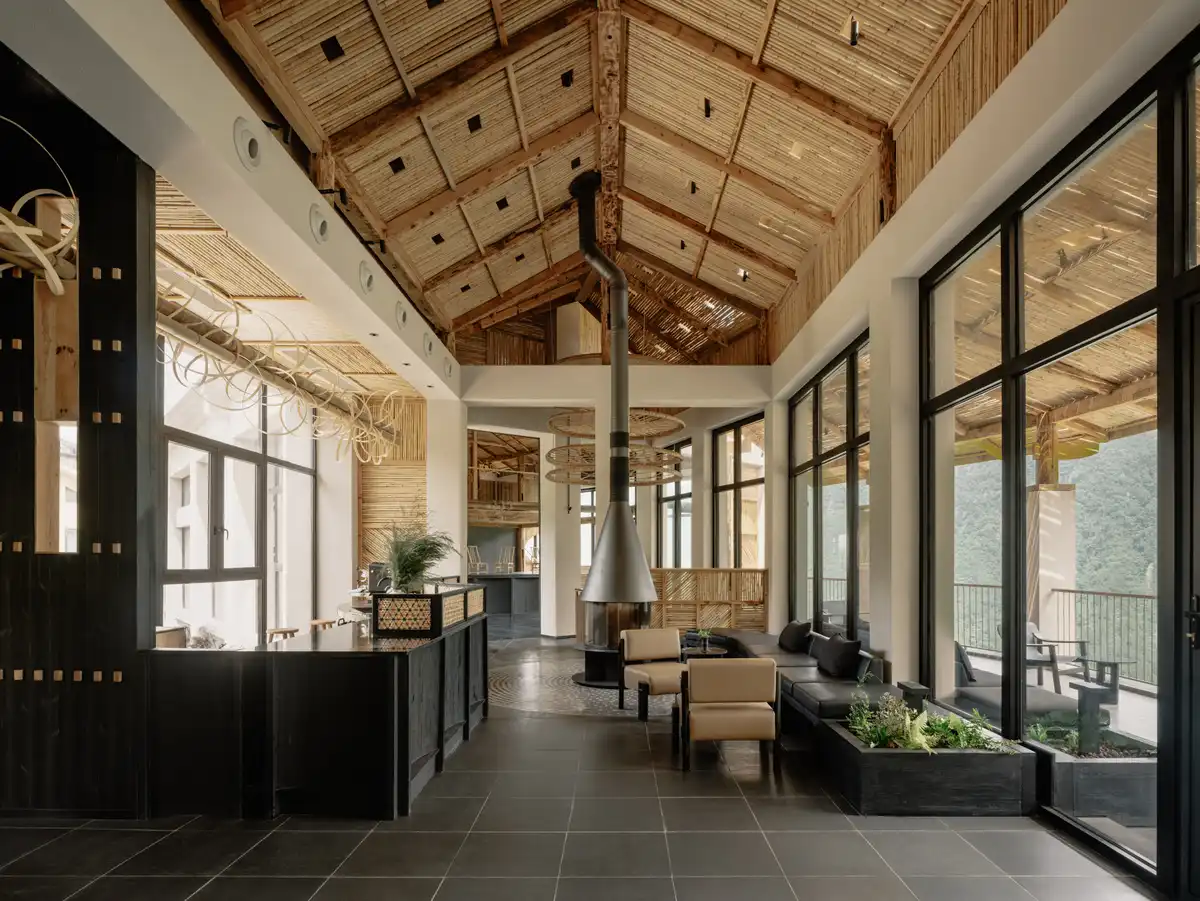
The upgrade of the building respects the local architectural characteristics of Chongqing (any floor may be the entrance to the building). The hotel lobby level (the top floor of the building) is entered through the entrance yard and the connection bridge. Following the long strip structure of the building itself, the entrance reception, waiting, elevator hall, lobby bar, multi-functional stage, public bathroom, and mezzanine office area functions are arranged open level by level. All functions face the mountain landscape, retaining the progressive levels of space and the circular continuity of the external view.
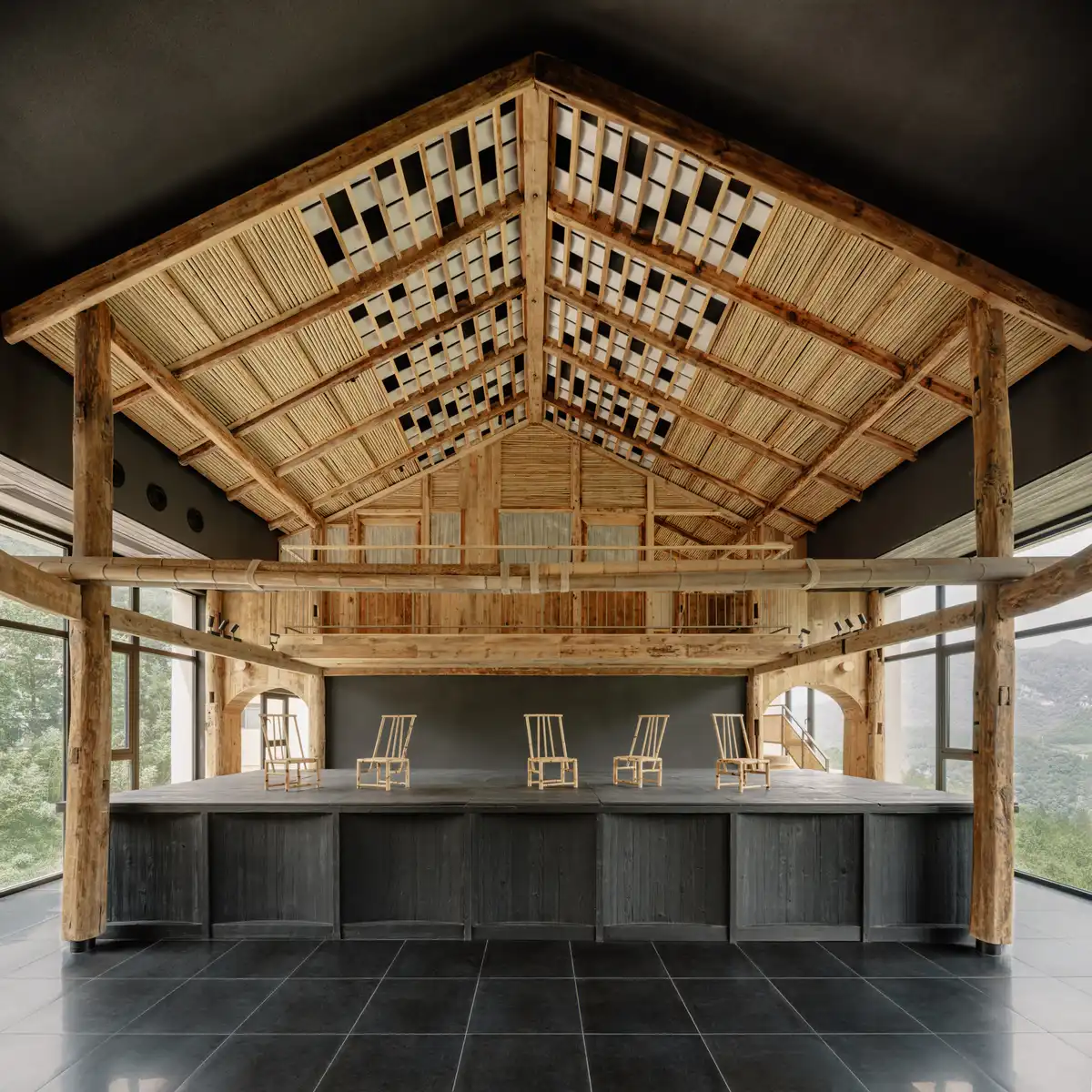
Upon entering the reception lobby from the main entrance, we aim to create a sense of continuity by incorporating mountain-inspired elements. We draw from the structural logic of local architectural styles and materials. Our design features bamboo shoot shells sourced from the mountains, bamboo pieces, recycled materials from abandoned houses in the hills, carbonized wood with unique textures, bamboo-woven artworks, and special black stones from the area. Together, these elements seamlessly blend to introduce guests to a natural, mountain-inspired aesthetic.
Searching in the mountains – the continuation of the life of materials in nature and construction processes – the restaurant
The restaurant is located on the ground-floor podium of the building, formed by the expansion of the parking area of the building itself toward the mountain. There are kitchens, indoor dining areas, and outdoor areas arranged in a step-by-step progression from the inside to the outside in the direction of the hill, connecting the main 4-level building, the outdoor mountain area, and the courtyard entrance of the six rooms on the same level.
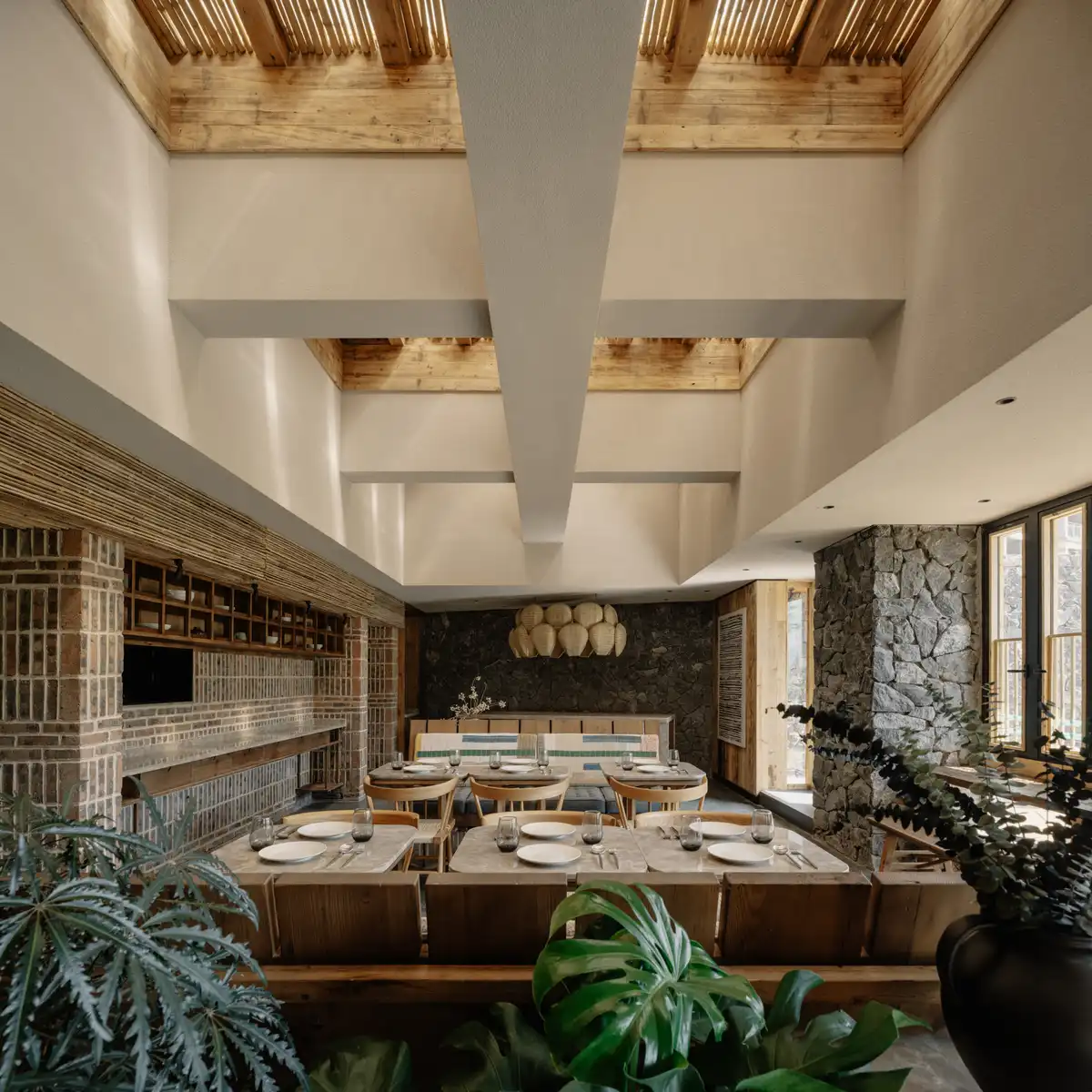
Through observing the construction process, we aim for the restaurant to not only reflect the overall style of the hotel but also embody the character of the mountains. We also intend to maximize the use of leftover, recycled materials and semi-finished products during construction to achieve a balance between quality, localization, and sustainability. This balance includes considerations of cost, design style, quality, and various other factors, presenting one of the opportunities for localization projects. By extending the original parking lot, we create a inviting hotel restaurant space filled with natural light and vibrant atmosphere and set up rooftop plants and viewing platforms. Maximize contact with nature.
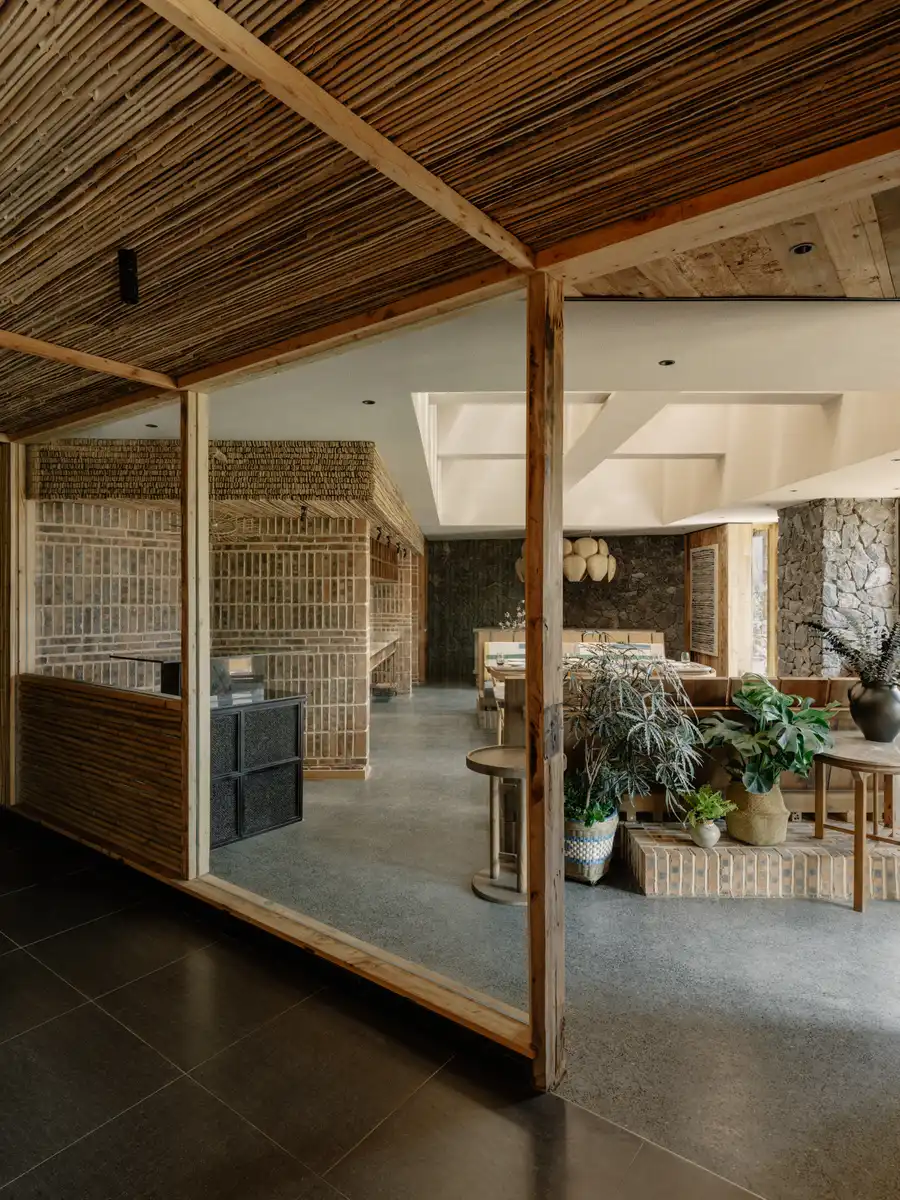
We utilized the red bricks that were removed during the construction process, as well as the semi-finished products from the bamboo weavers. Additionally, we incorporated the leftover bamboo treads from the construction and the black stones recovered from the mountains to create the reception area of the restaurant and the top surface of the entrance corridor and the terrazo floor.
The Details and Frame – the rooms
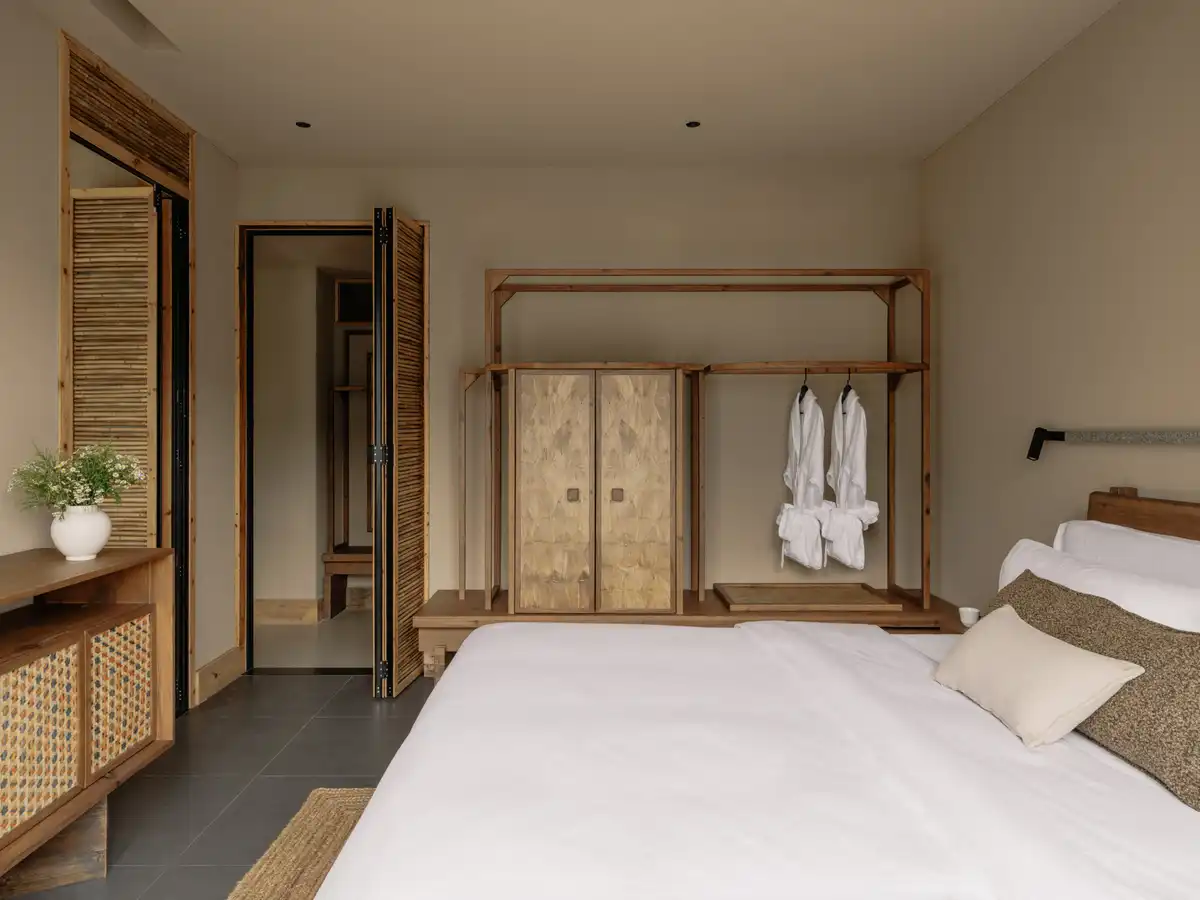
The building features 25 rooms arranged in a fan-shaped layout on the middle floor, all facing the mountain. To accommodate various customer needs, the rooms come in different types, including spacious and cozy courtyard rooms, high-floor suites, twin rooms, and standard king rooms.
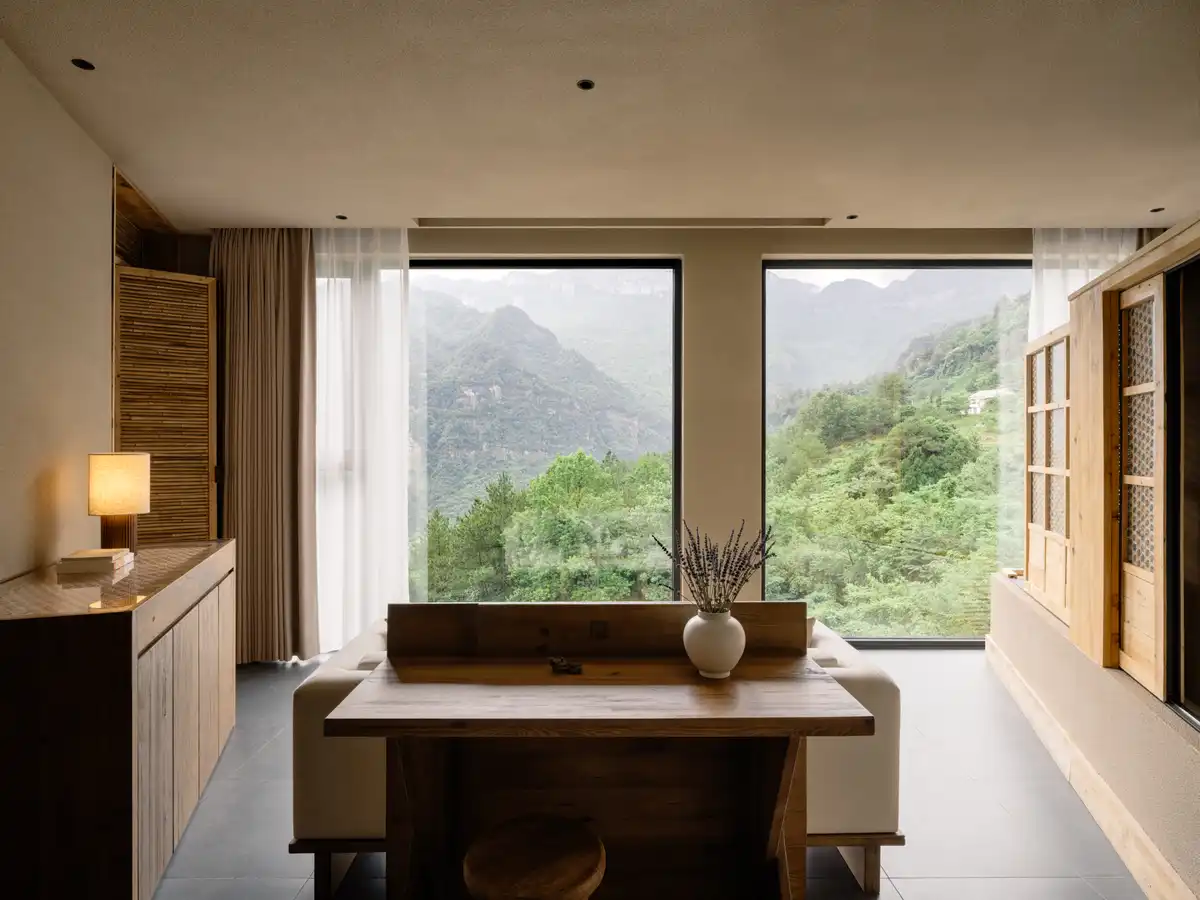
The room embodies the overarching design philosophy of the building, harmoniously incorporating earthy colors that seamlessly link the frame, natural materials, details, and artistic embellishments.and artistic embellishments.
Film on e-architect’s YouTube: Chinese B&B Building Design by RooMoo – 1.47 minutes
Cloudhaus Hotel, Yunlin Resort, Chongqing, China – Building Information
PROJECT INFO
Project City: Chongqing, China
Building area: 1915 sq m
Landscape area: 1560 sq m
Design Scope: Architectural renovation, Interior and landscape Design
Business type: B&B hotel
Design Team: RooMoo
Building & Interior Construction Team: Guixiang Construction Engineering Co., Ltd.
Customized Furniture and Bamboo Shoot Shells Finish: Yizhu Decoration Engineering Co., Ltd.
Wood Product and Stone Product: Chongqing Nanchuan District Dingteng Wood Processing Factory & Guixiang Construction Engineering Co., Ltd.
Lighting Consultant: WOY Lighting Co., Ltd.
Bamboo Rubbings & Part of Bamboo Installation: RooMoo Team
Primary materials: Stones collected from black mountains, recycled gray bricks, concrete drill cores, bamboo rafts, bamboo shoot shells, carbonized wood, recycled old wood, gray floor tiles, earth-colored exterior walls, and indoor artistic paint, local bamboo woven products, recycled red bricks, bamboo treads for construction
Project Location: Yunlin Resort Area, Jinfo Mountain, Chongqing, China
Photography: Wen Studio
Process photo provided by: RooMoo
Video on e-architect’s YouTube: Cloudhaus Hotel film
Cloudhaus Hotel, Yunlin Resort, Chongqing, China images / information received 051125
Location: Yunlin Resort, Chongqing, Southwestern China, eastern Asia
++
Chongqing Architecture Designs
Chongqing Architectural Designs in southwest China, selection from e-architect:
The Glade Bookstore, Chongqing
Architects: HAS design and research
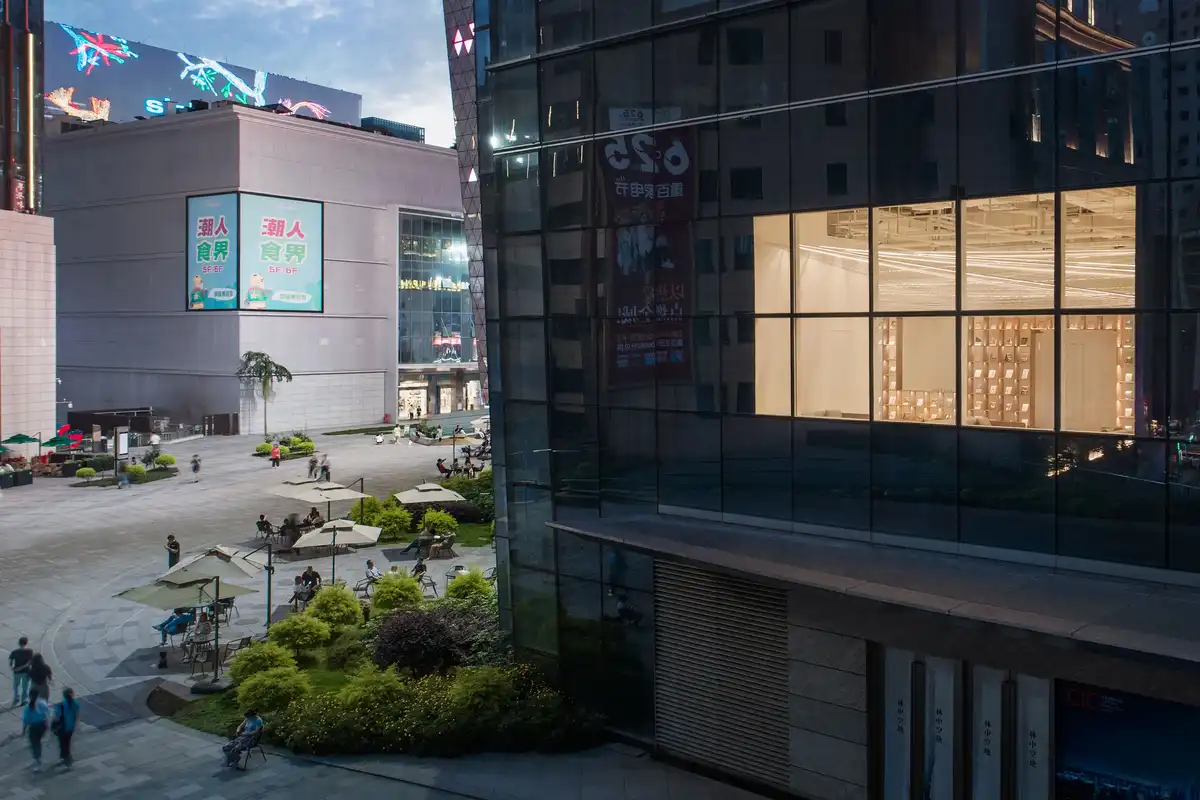
photo : Yu Bai
ChangXin Memory Technologies in Chongqing China, Shou County, Anhui
Architects: PH Alpha Design
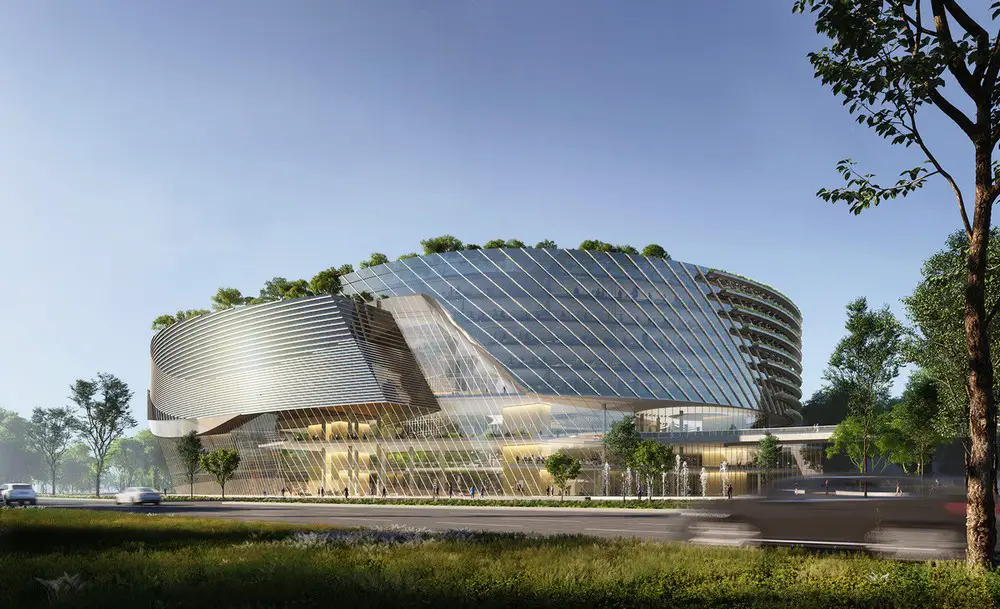
image : PH Alpha Design
Chongqing Gaoke Group Ltd Office Building
Design: Aedas
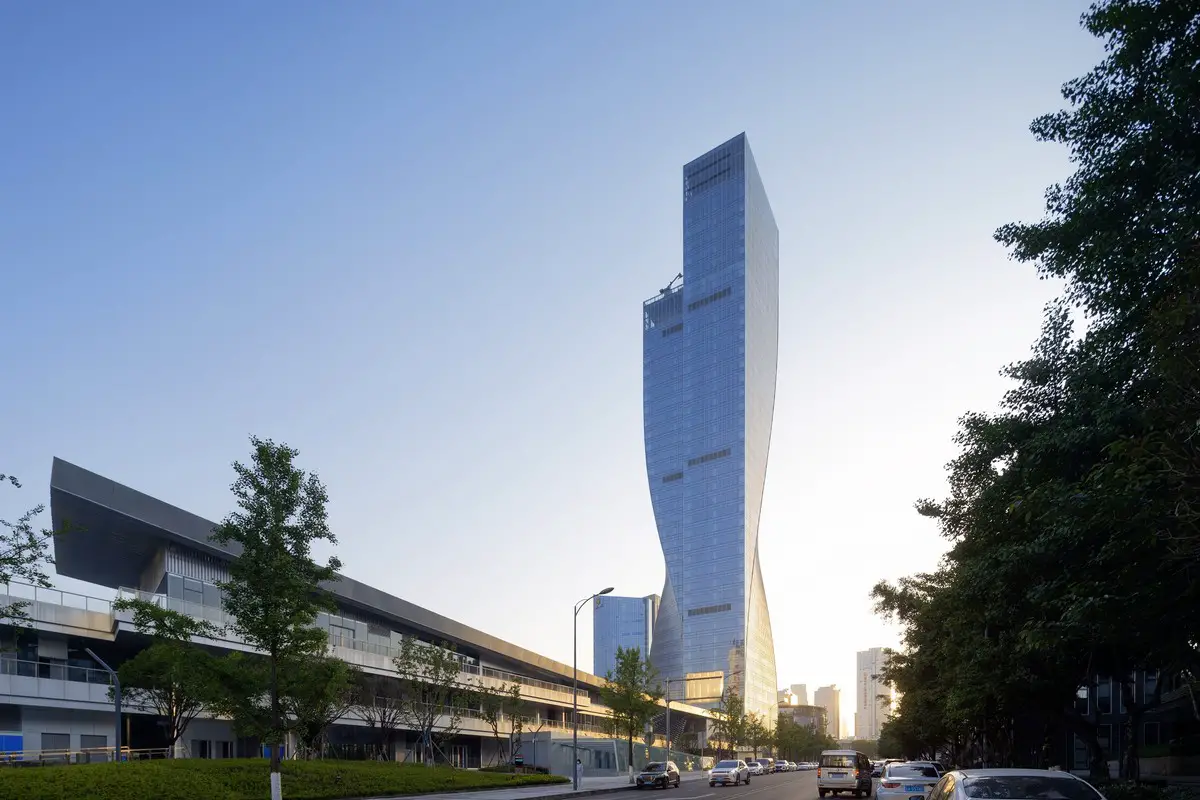
photo : Arch-Exist
++
Architecture in China
China Architecture Designs – chronological list
Chinese Architect – Design Practice Listings
Comments / photos for the Cloudhaus Hotel, Yunlin Resort, Chongqing, China designed by RooMoo architects studio page welcome.