Security by Design: Integrating Protection Into Architecture
2 July 2026
For most of architectural history, security was something added after the fact — bars bolted onto windows, alarm boxes screwed to finished façades, cameras clamped onto walls wherever they happened to fit. The building was designed first, and protection was retrofitted later, almost always at the expense of how the place looked and often at the expense of how well it actually worked. The result is familiar: beautiful buildings undermined by clumsy security, or secure buildings that feel like fortresses.
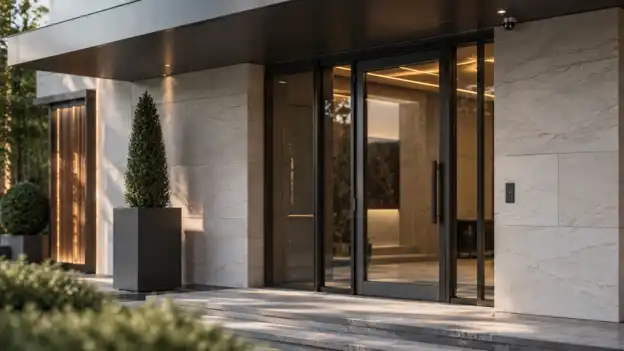
A better approach has taken hold. “Security by design” treats protection not as an afterthought but as a fundamental design parameter, considered from the first sketch alongside light, flow, and form. Done well, it produces buildings that are genuinely safer and better to inhabit — where the security is so thoroughly integrated that you barely notice it’s there. Here’s how modern architecture is bringing safety and aesthetics into alignment.
Why Retrofitting Fails
The case for designing security in from the start becomes obvious when you look at what happens when you don’t. Retrofitted security is almost always compromised on both fronts.
Aesthetically, it’s disruptive: surface-mounted conduit running across clean walls, cameras positioned for coverage rather than discretion, access panels interrupting carefully considered surfaces. Functionally, it’s often worse — a camera placed where there’s a convenient mounting point rather than where it eliminates a blind spot, or a lock added to a door that was never designed to accommodate it properly.
There’s a cost dimension too. Cutting into finished walls to run cabling, adding hardware that requires structural reinforcement after the fact, and reworking spaces to accommodate equipment is far more expensive than planning for it during construction. This is why architects increasingly collaborate with security specialists early in a project. Firms like lockandtech.com are brought into the conversation during design rather than after handover, so that cabling pathways, device locations, and access points are part of the plan from the beginning rather than problems to solve at the end. The shift is from reactive to proactive — and it changes the outcome entirely.
The Foundations – Designing Space Itself for Safety
The most elegant security is often invisible because it’s built into the arrangement of space rather than added as equipment. This is the domain of CPTED — Crime Prevention Through Environmental Design — a framework architects use to make spaces safer through their layout alone.
Natural surveillance designs sightlines so that spaces are easily overseen. Well-placed windows, open layouts, and thoughtful landscaping mean there are fewer hidden corners where someone could act unseen. A building that lets occupants and passersby naturally observe their surroundings deters trouble without a single camera.
Natural access control uses the design of paths, entrances, and landscaping to guide people toward intended routes and gently discourage them from others. A clearly defined entrance, a subtle change in paving, or a low planter can signal “this way” and “not there” far more pleasantly than a barrier or sign.
Territorial reinforcement uses design to express ownership of a space — clear boundaries between public and private, well-maintained thresholds — making it obvious where one belongs and where one doesn’t. Spaces that feel cared for and clearly defined are statistically less likely to be targeted.
These principles cost little because they’re matters of arrangement, not equipment. They’re the foundation on which technological security sits.
Integrating the Technology Invisibly
Once the spatial design is sound, the hardware layer — cameras, access control, sensors, lighting — can be integrated so it supports the architecture rather than fighting it.
Concealed cabling and infrastructure. When wiring routes are planned during construction, cameras and access readers connect through the structure invisibly, with no surface conduit. The device is all you see, and often you barely see that.
Discreet device placement. Designed-in cameras are positioned where they both cover the space effectively and recede visually — tucked into soffits, aligned with architectural lines, finished to match surrounding surfaces. Coverage and discretion stop being a trade-off.
Access control as architecture. Modern access systems — keypads, card readers, biometric scanners — can be integrated into walls, door frames, and entry sequences as considered design elements rather than bolted-on boxes. A reader flush-mounted into a stone surround reads as part of the entrance, not an intrusion on it.
Lighting that does double duty. Thoughtful lighting design serves ambiance and security simultaneously. The same scheme that makes an entrance welcoming at night also eliminates the shadows that compromise safety, and motion-responsive lighting can be both elegant and protective.
Material and structural choices. Security-rated glazing, reinforced doors, and robust materials can be specified to meet protection requirements while looking identical to their standard counterparts. The strength is in the specification, invisible in the finish.
The Convergence of Physical and Digital
A defining feature of contemporary security-by-design is that the building’s systems increasingly talk to one another. Access control, surveillance, lighting, and environmental systems integrate into a unified platform, often managed from a single interface and connected to the building’s broader smart infrastructure.
This integration is itself a design consideration. It affects where equipment rooms go, how networks are routed, and how the building’s digital backbone is structured. Planning for it early means the building is ready for current technology and adaptable to future systems — a meaningful advantage given how quickly security technology evolves. A building designed with integration in mind ages far more gracefully than one where each system was added in isolation.
It also raises a consideration architects increasingly account for: networked security devices are part of a building’s digital attack surface. Designing for security now means thinking about both the physical and the cyber dimensions together, ensuring the systems meant to protect a building don’t become vulnerabilities themselves.
Collaboration Is the Real Method
If there’s a single principle underlying security by design, it’s that good outcomes come from collaboration early. When architects, security specialists, and clients work together from the schematic phase, security requirements shape the design rather than disfigure it. The security professional identifies vulnerabilities and needs; the architect finds ways to address them that enhance rather than compromise the design; the client gets a building that is both beautiful and genuinely protected.
This is a different model from the traditional sequence, where the architect finishes and a security vendor is called in to bolt on equipment. It requires bringing the right expertise to the table early and treating protection as one of the project’s design drivers, on par with sustainability or accessibility — both of which followed exactly this same evolution from afterthought to integrated priority.
The Bottom Line
Security and aesthetics were never truly opposed; they only appeared that way because security was so often handled badly and late. When protection is treated as a design parameter from the first sketch — woven into the arrangement of space, integrated invisibly into the structure, and planned through genuine collaboration between architects and security experts — the false choice between safety and beauty dissolves. The building that results is more pleasant to occupy, more cost-effective to protect, and more adaptable to the future. In the best examples, you experience a space that simply feels good and safe, without ever seeing the work that makes it so. That invisibility isn’t an absence of security. It’s security done right.
Comments on this guide to Security by Design: Integrating Protection Into Architecture article are welcome.
Home Security
House Security Posts
How to choose a home security system
Boost the Security of Your Home
What are some of best home security products
Architectural Design and Security
Property
Residential Architecture
Comments / photos for the Security by Design: Integrating Protection Into Architecture page welcome